What Tap Goes With A Freestanding Bath? Bath Filler Guide | Elani
A free standing bath filler is the most considered choice for a freestanding bath. Why, and how to choose the right finish.
August 10, 2026
4 minutes
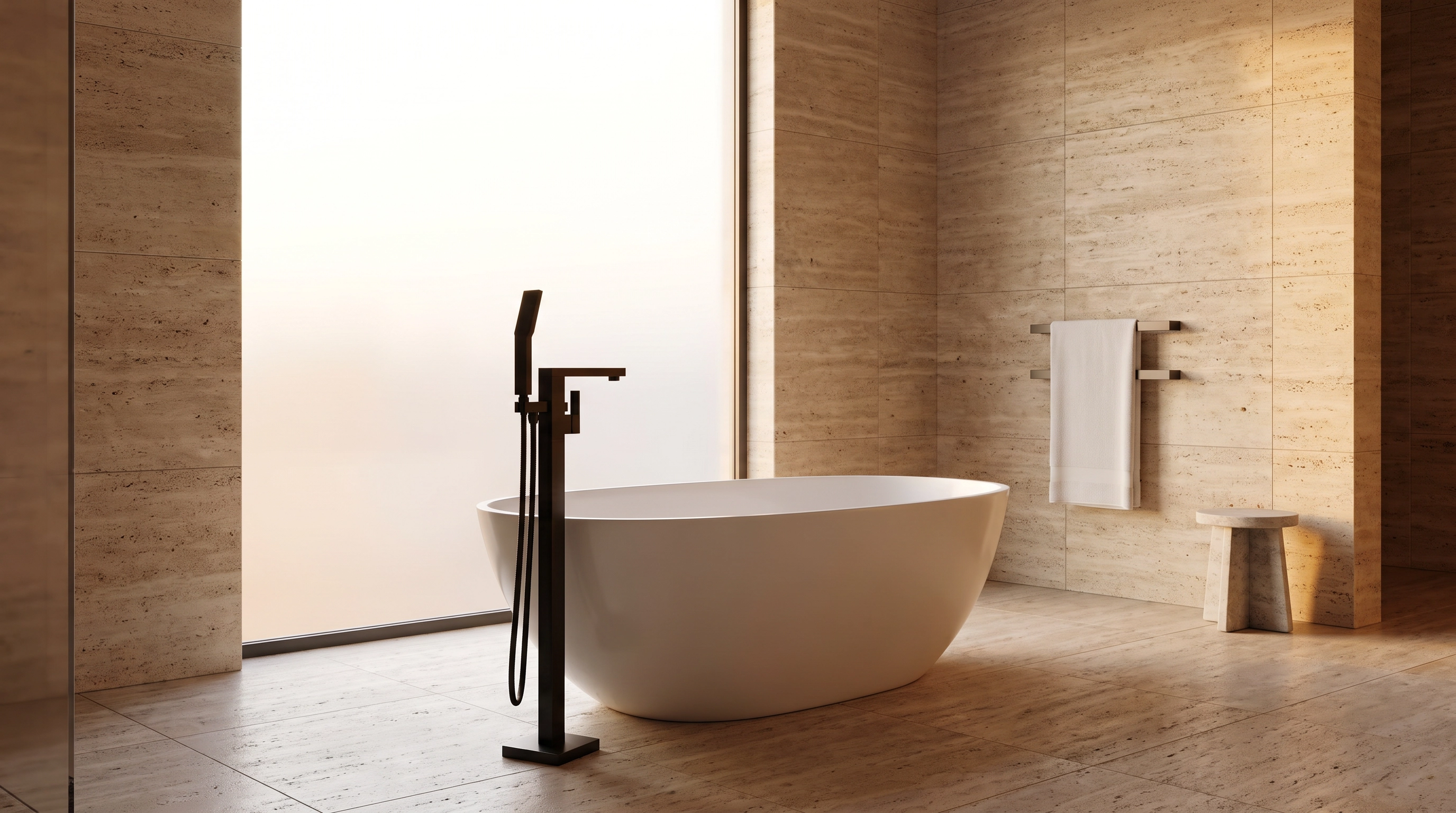
A free standing bath filler is the most considered choice for a freestanding bath. Why, and how to choose the right finish.
August 10, 2026
Get the bath right and the tap can undo it if it's chosen as an afterthought — it's one of the few decisions in a bathroom that's genuinely dictated by the format, not just style.
The most considered choice is a floorstanding bath filler — sometimes written free standing bath filler — a tap that rises from the floor beside the bath on two floor-fixed risers, with the spout positioned to fill the bath without being mounted on it. This keeps the bath's exterior clean and uninterrupted, which is part of the point of choosing a freestanding design in the first place.
Last updated 27 August 2026 · Elani Journal
Most sculptural or rolltop freestanding baths don't have a flat rim designed to take a deck-mounted tap, and a fully freestanding bath rarely sits near a wall a tap could be mounted to. A floorstanding filler solves both problems — it's plumbed independently of the bath itself, which is exactly why it became the standard solution for the format.
Wall-mounted taps can work well for a back-to-wall bath positioned against a wall, where there's a surface to fix to. Deck-mounted taps only suit baths with a flat rim built to take one — check the bath's specification before assuming this is an option. For a fully freestanding bath with no wall behind it and no flat deck, floorstanding is typically the only format that makes practical sense. Elani's freestanding bath taps and bath fillers cover both the floorstanding and wall-mounted formats.
The tap should match whatever finish runs through the rest of the room's hardware, rather than being chosen in isolation — brushed brass, matte black, or brushed gunmetal, depending on the scheme. It doesn't need to match the shower fittings exactly, but a considered bathroom generally reads better when the metal finishes across the room are coordinated rather than competing.
Floorstanding fillers require floor-mounted pipework — risers fixed to the floor and fed from below — which is more involved than a standard wall or deck tap. Positioning needs to be planned before flooring goes down, ideally with a plumber who has fitted freestanding fillers before, since the spout needs to reach the bath comfortably without being close enough to interfere with getting in and out.
Elani's Noir (matte black, £449.99) and Doré (brushed gold, £529.99) floorstanding fillers are built for exactly this — a classical roll-top like the Ondine pairs particularly well with Doré's warmth. For the full sizing and styling guide, see Freestanding Bath Taps, or browse the full freestanding bath range.
A free standing bath filler (also written floorstanding bath filler) is a tap that rises from the floor on two fixed risers beside the bath, rather than mounting to the bath itself or a nearby wall. It's the standard tap format for sculptural and rolltop freestanding baths, which rarely have a flat rim or adjacent wall a tap could otherwise fix to.
Only if the bath has a flat rim designed to take one — most sculptural or rolltop freestanding baths don't, which is why floorstanding fillers became the standard solution for the format.
It's not required, but it reads as more considered when the tap finish matches — or deliberately contrasts with intent — the rest of the room's hardware, rather than being chosen in isolation.
They require floor-mounted pipework fed from below, which is more involved than a standard wall or deck tap. This is why positioning needs to be planned before flooring goes down, ideally with a plumber experienced in fitting them.
Oval and slipper silhouettes remain the most widely chosen, though fluted and textured exteriors have become the standout choice for anyone wanting the bath itself to be the room's focal point. The full Elani bath collection covers both.