Freestanding Bath Taps — Floor, Wall Or Deck? | Elani
Which tap suits your bath depends on whether it has tap holes and where the pipework runs — and floorstanding has to be decided before the floor goes down.
July 20, 2026
5 minutes
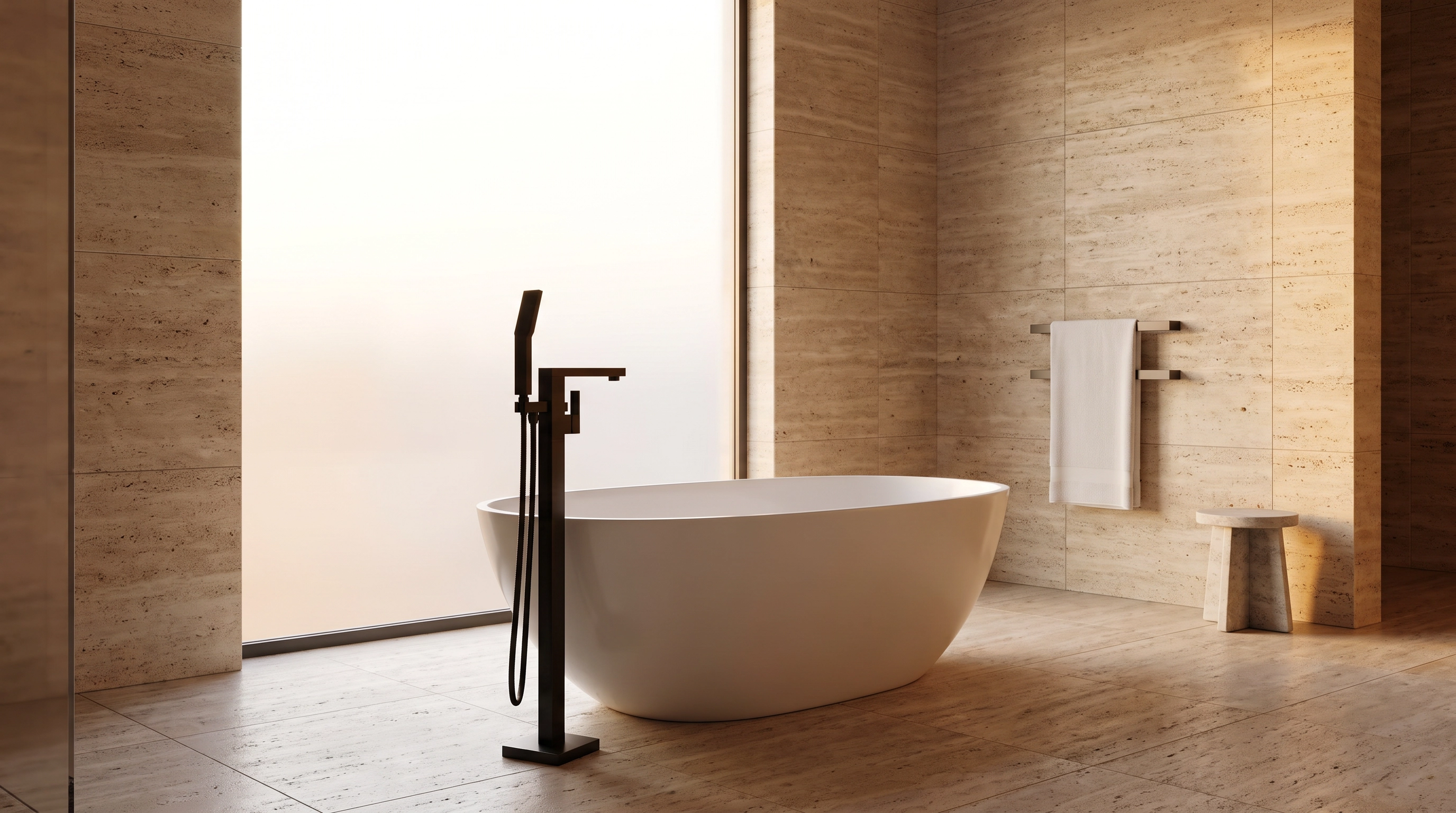
Which tap suits your bath depends on whether it has tap holes and where the pipework runs — and floorstanding has to be decided before the floor goes down.
July 20, 2026
A freestanding bath is a decision about presence. The tap is the decision that follows — and it matters more than most people expect.
Because a freestanding bath has no rim against a wall, no tiled ledge, and often no surface nearby at all, the tap cannot simply be an afterthought bolted to the nearest convenient point. It has to be chosen, positioned, and planned. Done well, the tap completes the bath. Done poorly, it is the detail that undermines everything else in the room.
This is the complete guide to getting it right.
Last updated 24 August 2026 · Elani Journal
There are three ways to fill a freestanding bath: a floorstanding filler that rises from the floor beside the bath, a wall-mounted filler for baths positioned close to a wall, and a deck-mounted tap for baths with a flat enough rim to accept one.
The floorstanding bath filler. A tap that rises from the floor beside the bath on one or two fixed risers, with the spout reaching over the rim. This is the classic freestanding bath tap — and for a fully freestanding bath positioned away from the walls, it is usually the only option. It is also the most visually striking: a floorstanding filler standing beside a sculptural bath reads as a considered pairing, two vertical forms in conversation.
The wall-mounted filler. Where the bath sits close to a wall — a back-to-wall design like the Elani Reede, or a freestanding bath positioned within reach — a wall-mounted spout and controls keep the floor completely clear. The result is cleaner underfoot and simpler to install where the wall cavity is accessible. The trade-off is commitment: the bath's position is fixed by the plumbing forever.
The deck-mounted tap. Some freestanding baths have a flat enough rim to accept a conventional deck-mounted tap. It is the most economical route, but rarely the most considered one — a deck-mounted tap interrupts the line of the bath itself, which is precisely the thing a freestanding bath is chosen for. If the silhouette matters, keep the rim clean.

A floorstanding filler is the considered choice because it leaves the bath's rim and exterior completely untouched, filling the bath from a tall spout rather than interrupting its silhouette.
A floorstanding bath filler does something no other tap can: it leaves the bath entirely untouched. The rim stays clean. The exterior — fluted, textured, or smooth — runs uninterrupted. The bath remains the sculptural object it was chosen to be, and the tap stands beside it as a complementary piece rather than an attachment.
There is also a practical case. Floorstanding fillers position the spout high above the rim, filling the bath quickly and comfortably. Most include a handheld shower attachment — genuinely useful for rinsing the bath after use, and for washing hair without a full shower.
Planning the plumbing for a floorstanding filler means deciding the bath and tap position before the floor is finished, allowing 150–250mm clearance for the spout, checking water pressure suits a tall filler, and confirming the floor construction can anchor it securely.
This is the part to get right early, because it happens under the floor.
Supply pipes. A floorstanding filler is fed by hot and cold supply pipes that rise through the floor at the tap's fixing point. These need to be run before the floor is finished — which means the bath's position, and the tap's position beside it, must be decided at planning stage, not after tiling.
Position. The filler typically stands beside the bath at its centre point, or toward the tap end on a single-ended design. Allow enough clearance for the spout to reach over the rim — most floorstanding fillers are designed to stand 150–250mm from the bath's edge.
Water pressure. Floorstanding fillers perform best on higher-pressure systems — mains-fed combi or unvented systems are ideal. On a low-pressure gravity-fed system, check the tap's minimum pressure rating before committing. A tall filler on a weak system fills slowly, and a slow-filling freestanding bath is a daily frustration.
Floor construction. Solid floors need the pipe runs planned into the screed. Timber floors are more forgiving — pipes run between joists — but the fixing point still needs solid support. The filler is a tall lever; it must be anchored properly.
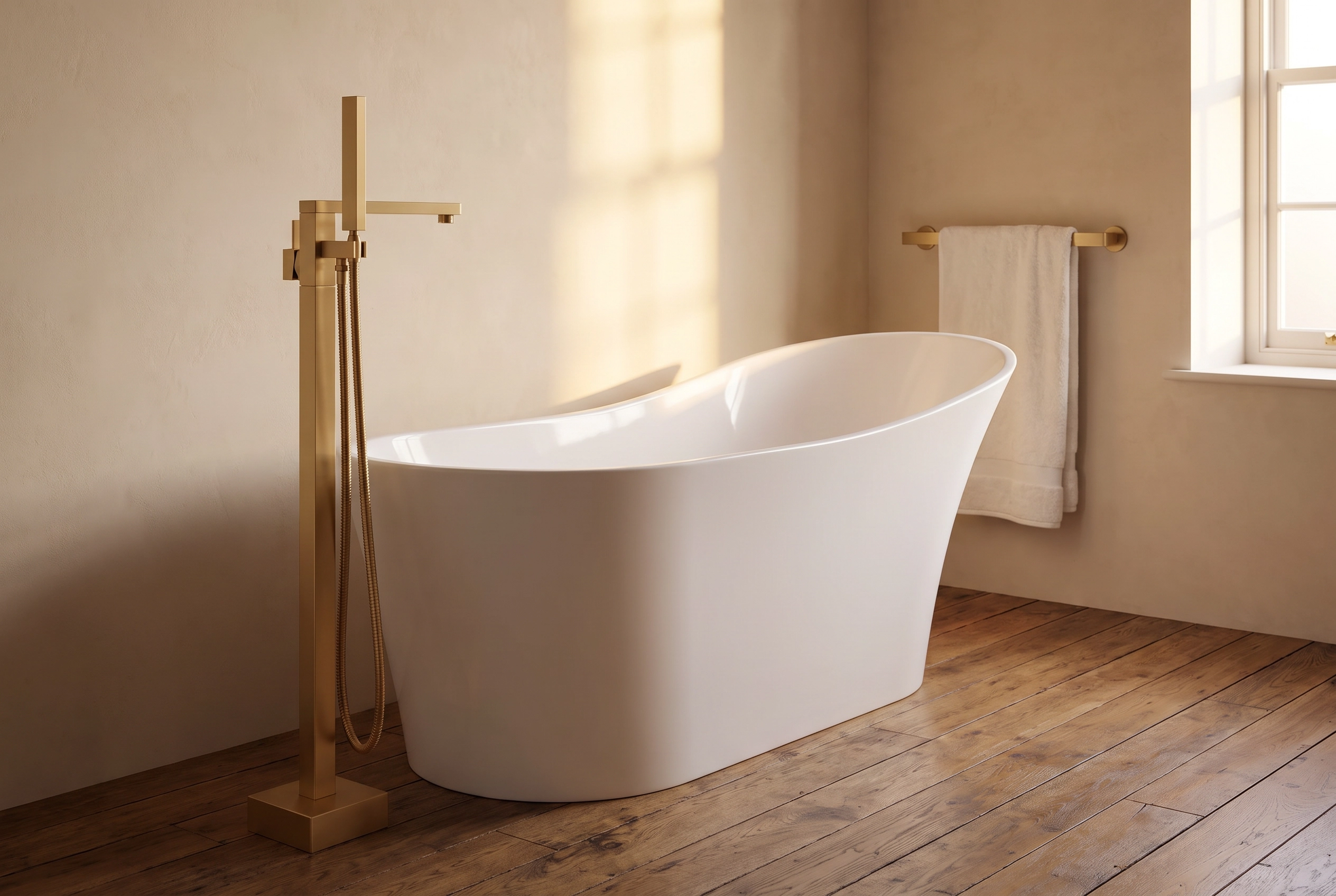
The tap finish should always match the room's existing hardware: matte black for a contemporary scheme, brushed gold for a warm quiet-luxury palette, and chrome only as a default rather than a considered choice.
The tap finish should match the rest of the room's hardware — this is the single most reliable rule in bathroom design. A brushed brass bathroom takes a brushed gold filler. A room built around depth and shadow takes matte black or brushed gunmetal. What it should never do is introduce a fourth finish to a room that already has three.
Matte black is the definitive choice for the contemporary freestanding bath. Against a white or stone bath, a matte black filler reads as a drawn line — precise, graphic, deliberate. It pairs naturally with the matte black hardware family: the Circa mirror, the Edge accessories.
Brushed gold brings warmth. Beside a white bath in a travertine or warm-plaster room, a brushed gold filler completes the quiet luxury palette that defines the considered bathroom in 2026. It belongs to the same warm-metal family as the Aurum Collection — and a genuine PVD brushed gold finish holds its colour in a wet environment in a way that plated alternatives cannot.
Chrome remains the default — and that is its problem. In a room where everything else has been chosen with intention, a chrome tap reads as the one decision that wasn't made.
Elani's two floorstanding bath fillers were specified for exactly the rooms described above.
The Noir — floorstanding bath filler in matte black. A single-lever filler with handheld rinse, designed to stand beside a sculptural bath without competing with it. The natural companion to the Onyx bath, the Edge accessory set, and the matte black bathroom. £454.99.
The Doré — floorstanding bath filler in brushed gold PVD. The same considered form in a warm, precise finish that pairs with the Aurum Collection and the travertine-and-stone palette of the quiet luxury bathroom. £484.99.
Both ship within the UK only.
Choosing the bath first? Our freestanding bath ideas guide covers every style, size, and positioning decision — the tap follows naturally from there.

Usually, yes. A fully freestanding bath positioned away from the wall needs either a floorstanding bath filler — a tap that rises from the floor beside the bath — or, if the bath sits close to a wall, a wall-mounted filler with a long-reach spout. Conventional deck-mounted taps only work on freestanding baths with a wide, flat rim, and they interrupt the bath's silhouette.
A floorstanding bath filler is fed by hot and cold supply pipes that rise through the floor at its fixing point. The tap is anchored to the floor beside the bath, with the spout positioned to reach over the rim. The pipe runs must be installed before the floor is finished, so the bath and tap positions need to be decided at planning stage.
Most floorstanding bath fillers stand between 900mm and 1,100mm tall — high enough for the spout to clear the rim of a standard freestanding bath (typically 550–600mm high) with comfortable clearance. Check the spout height against your specific bath's rim height before ordering; the spout should sit 150–250mm above the rim.
They perform best on mains-pressure systems — combi boilers or unvented cylinders. Most floorstanding fillers specify a minimum working pressure, commonly 1.0 bar or above. On a gravity-fed low-pressure system, a tall filler will fill slowly. Check the tap's minimum pressure rating against your system before committing.
Match the tap to the room's existing hardware finish — matte black with matte black accessories, brushed gold with warm brass hardware, brushed gunmetal in darker rooms. The tap should never introduce a new finish to the room. Against a white or stone bath, matte black reads as contemporary and graphic; brushed gold reads as warm and classical.
Yes, if the bath sits close enough to the wall — typically within 300mm. A wall-mounted filler keeps the floor clear and suits back-to-wall freestanding designs particularly well. The spout needs sufficient reach to clear the bath's rim and deliver water toward the centre of the bath rather than down its inside edge.