Freestanding Bath Ideas — Choose The Right Style | Elani
Sculptural or classical? Oval or slipper? Our 2026 guide covers every freestanding bath style, size, and consideration. UK delivery available.
May 17, 2026
5 minutes
Sculptural or classical? Oval or slipper? Our 2026 guide covers every freestanding bath style, size, and consideration. UK delivery available.
May 17, 2026
A freestanding bath is rarely a practical decision. Nobody needs one. But those who choose one understand something important — that the bathroom, more than any other room in the home, is where the day begins and ends. It deserves to be considered.
The question is never whether to have a freestanding bath. It is which one.
Last updated 24 August 2026 · Elani Journal

Freestanding baths fall into four main categories: sculptural and textured baths that lead with form, versatile oval and slipper baths, space-efficient back-to-wall baths, and bold statement or translucent baths for a genuinely unique room.
Freestanding baths broadly fall into four categories. Understanding which suits your space, your lifestyle, and your aesthetic is the starting point for every good decision.
Sculptural & Textured BathsThese are baths that lead with form. Diamond textures, basket weave exteriors, rippled surfaces — each one is as much a piece of design as it is a functional object. They work best in bathrooms with restraint elsewhere, where the bath can be the singular point of interest.
The Elani Facet and Ingrid sit firmly in this category — baths that demand to be looked at before they are ever stepped into.
Oval & Slipper BathsThe most versatile of all freestanding bath styles. A clean oval form works in almost any bathroom — contemporary, transitional, or traditional — without asking the rest of the room to compromise. The slipper variation adds a raised back for additional head support and a more classical silhouette.
The Elani Forme and Crest represent this style at its most refined, alongside the more compact Reverie and the classical roll-top Ondine.
Back To Wall BathsDesigned to sit flush against a wall rather than float freely in the room, back to wall baths are the practical choice for smaller spaces or those who prefer wall or deck mounted taps. They offer all the visual appeal of a freestanding bath with the added convenience of tap placement flexibility.
The Elani Reede — with its deeply grooved fluted exterior — brings this format firmly into contemporary design territory, alongside the more compact Arête and the softly D-shaped Anse. Browse the full back-to-wall collection.
Statement & Translucent BathsFor those who want the bathroom to be genuinely unlike any other. Translucent resin baths in deep colour — red, blue, black — exist in a category entirely their own. They are not for every bathroom, but in the right space they are unforgettable.
The Elani Inferna and Aquaire belong here.
Bath size should scale with the room: around 1500mm and back-to-wall for a small bathroom under 4m², 1600–1700mm for a medium bathroom, and 1700–1800mm as a fully freestanding centrepiece for a large bathroom, with at least 600mm clearance on all sides.
Size is where most people make their first mistake — and almost always in the same direction. They choose too small.
A freestanding bath that is too small for the room looks awkward and self-conscious. One that fills the space with confidence looks intentional.
As a general guide:
Always measure your available floor space and allow a minimum of 600mm clearance on all sides of the bath for comfortable access and visual breathing room. For the fuller picture on planning a compact bathroom — basin, mirror and storage included, not just the bath — see Small Bathroom Ideas — The Elani Guide.
The four main positions for a freestanding bath are centre of the room for maximum drama, against a feature wall for practicality, in a bay or alcove in period properties, and beside a window for natural light.
Where you place a freestanding bath matters as much as which one you choose.
Centre of the room is the most dramatic option — the bath becomes the room's focal point and the space is designed around it. Works best in larger bathrooms with strong natural light.
Against a feature wall is the most practical and increasingly the most popular. The bath sits proud of the wall with clearance on three sides, creating presence without dominating the entire floor plan.
In a bay or alcove works beautifully in period properties — the architecture frames the bath naturally and creates an intimate bathing space within the larger room.
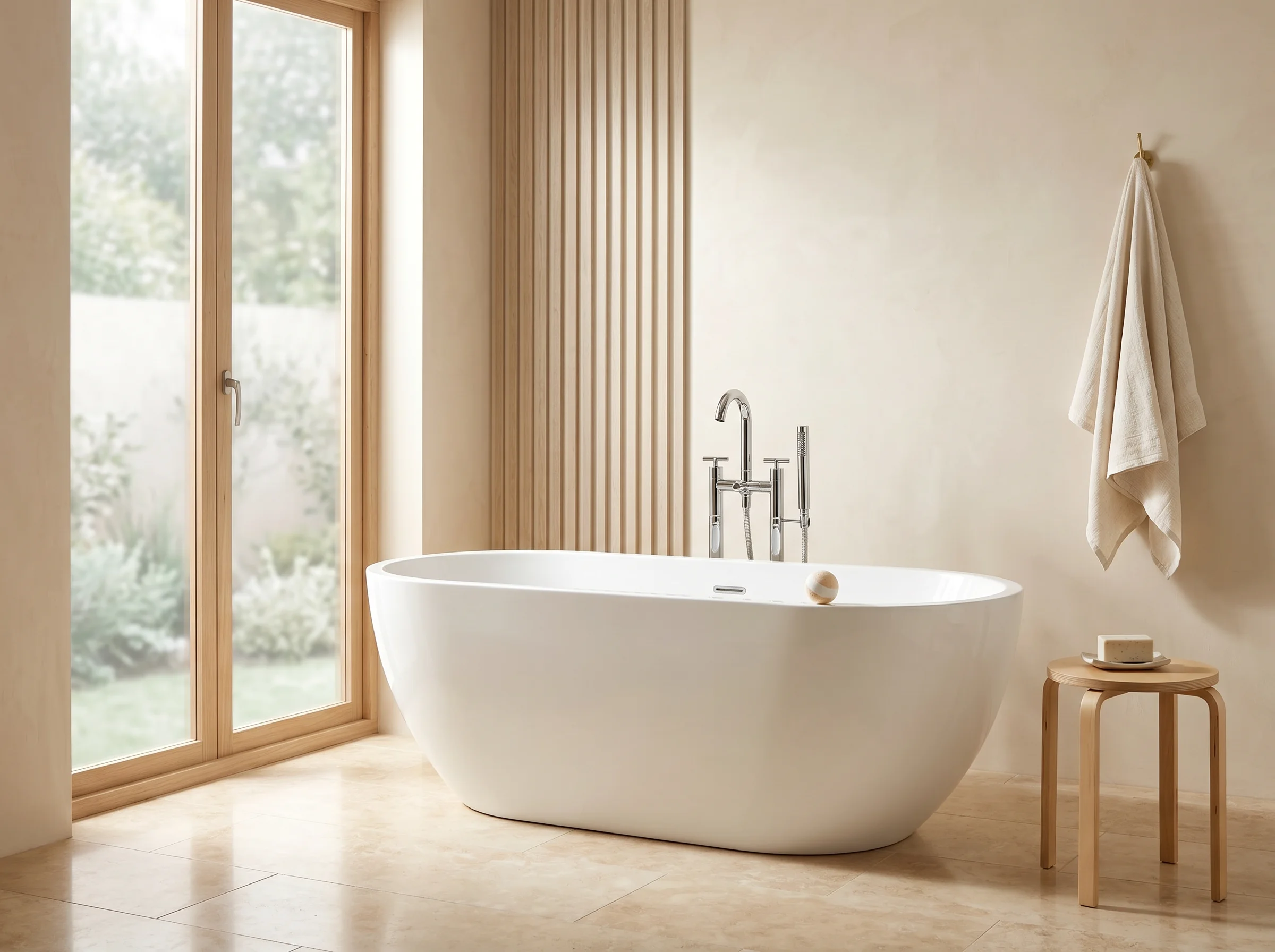
Beside a window is perhaps the most aspirational placement of all. Natural light, a view, and the sensation of bathing in the open — few things in a home feel as considered.
Match the bath to the room's style: clean oval forms for contemporary and minimal interiors, fluted or ribbed exteriors for textured schemes, roll-top and slipper silhouettes for traditional bathrooms, and translucent or sculptural baths for bold, expressive spaces.
Contemporary & MinimalClean oval forms, slim flat lips, and no decorative detail. The bath should feel like it belongs to the architecture rather than interrupting it. The Elani Forme is the natural choice here.
Textured & TactileFluted walls, ribbed surfaces, and woven exteriors are at the forefront of bathroom design right now. The Elani Reede and Deco bring this trend to the bath itself — a considered evolution beyond the feature wall.
Traditional & ClassicalRoll top edges, slipper silhouettes, and pedestal bases. The Elani Crest bridges heritage design and contemporary living without feeling dated.
Bold & ExpressiveIf the bathroom is your canvas, choose accordingly. The Elani Inferna and Aquaire exist for interiors that refuse to be ordinary — as does the monolithic Onyx for a matte black statement instead of colour.
Before ordering, confirm three things: the bath's lead time, whether the tap will be floorstanding, wall-mounted or deck-mounted, and that the floor can support the bath's weight — often 300kg or more when full.
Beyond aesthetics, three things matter:
Lead time — Some baths are crafted to order and require several weeks. Others are UK based and ready to deliver within days. Know your timeline before you commit.
Tap placement — Freestanding baths typically require a floor standing tap. Back to wall designs allow for wall or deck mounting. Confirm your plumber's preference before ordering.
Floor loading — A full freestanding bath can weigh 300kg or more including water. Always confirm your floor can support the weight, particularly in older properties or upper floor bathrooms.
Every bath in the Elani Classic Collection is UK based and delivered within 3–5 working days, backed by a 7-year manufacturer's warranty. From the geometric precision of the Facet to the classical grace of the Crest — there is a bath in this collection for every interior and every intention.
Explore The Classic Collection →
As a practical minimum, allow at least 600mm of clearance on each side and at the end of the bath to move around it comfortably. A bath positioned with access on all four sides needs clearance on every face. In a smaller bathroom, a back-to-wall freestanding bath (which sits against one wall) requires clearance on only three sides, making it viable in rooms where a fully freestanding position is not possible.
The oval slipper bath and the straight-sided double-ended bath are the two most consistently popular shapes. The oval slipper is the classic freestanding silhouette — raised at one or both ends, narrowing gently toward the middle. The straight-sided double-ended bath (like the Elani Reede) has a more contemporary profile — clean vertical exterior walls with a flat base — and suits modern rooms where the classic curved slipper would feel period.
Yes, when the internal profile is designed for it. The interior shape matters more than the exterior — a well-designed freestanding bath has an angled back that supports the body at a comfortable reclining angle. The Reede's back-to-wall positioning means the wall provides additional structural support and keeps the bath stable. Depth also matters: a bath shallower than 440mm interior depth will not submerge the body adequately for a full soak.
Not necessarily, but plumbing planning is more important than for a built-in bath. The floor waste needs to be positioned directly under the bath's waste outlet, which must be planned before tiling. The tap supply pipes either run through the floor (for freestanding floor-mounted taps) or come from a wall-mounted position. Floor-mounted taps require supply pipes under the floor — best planned at the same time as the bath position is decided.
The most considered choice is a floorstanding bath filler — a tap that rises from the floor beside the bath on two floor-fixed risers, with the spout positioned to fill the bath without the tap being mounted on the bath itself. This keeps the bath's exterior clean and uninterrupted. The tap finish should match whatever finish is used for the rest of the bathroom hardware — brushed brass, matte black, or brushed gunmetal, depending on the room.