The Sculptural Bath: 2026's Real Statement | Elani
Colour had its moment. In 2026, the freestanding bath's shape is doing the talking. A look at the silhouettes defining the considered bathroom.
August 17, 2026
5 minutes
Colour had its moment. In 2026, the freestanding bath's shape is doing the talking. A look at the silhouettes defining the considered bathroom.
August 17, 2026
For a few years, the bathroom conversation was almost entirely about colour — matte black, brushed brass, the slow retreat from cool white tile. That conversation isn't over. But walk into any considered bathroom being built this year and the bigger shift is quieter than colour: it's shape.
The freestanding bath is no longer just a fixture chosen in a finish. It's being chosen as a form — a deliberate silhouette that anchors the room the way a piece of furniture would, not a piece of plumbing. Curved geometry is replacing hard, sharp lines. Sculptural, almost architectural profiles are taking the place of the standard oval tub. The bath has become the one object in the room allowed to have real presence.
It's not a coincidence that this is happening alongside the rise of spa-style bathrooms at home — deep soaking tubs, considered materials, a room built to slow you down rather than move you through it. A sculptural bath is what makes that feeling physical.
Last updated 24 August 2026 · Elani Journal
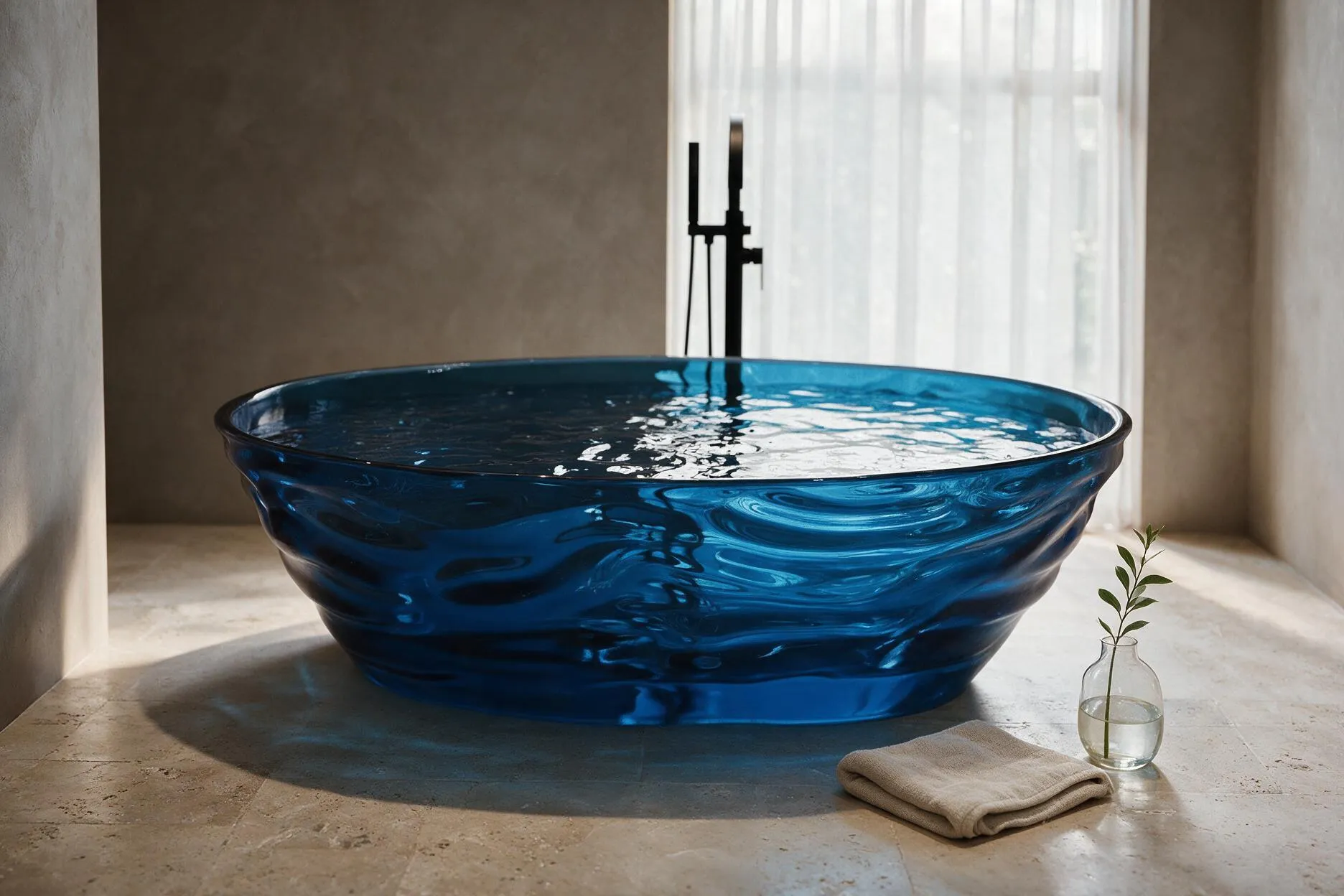
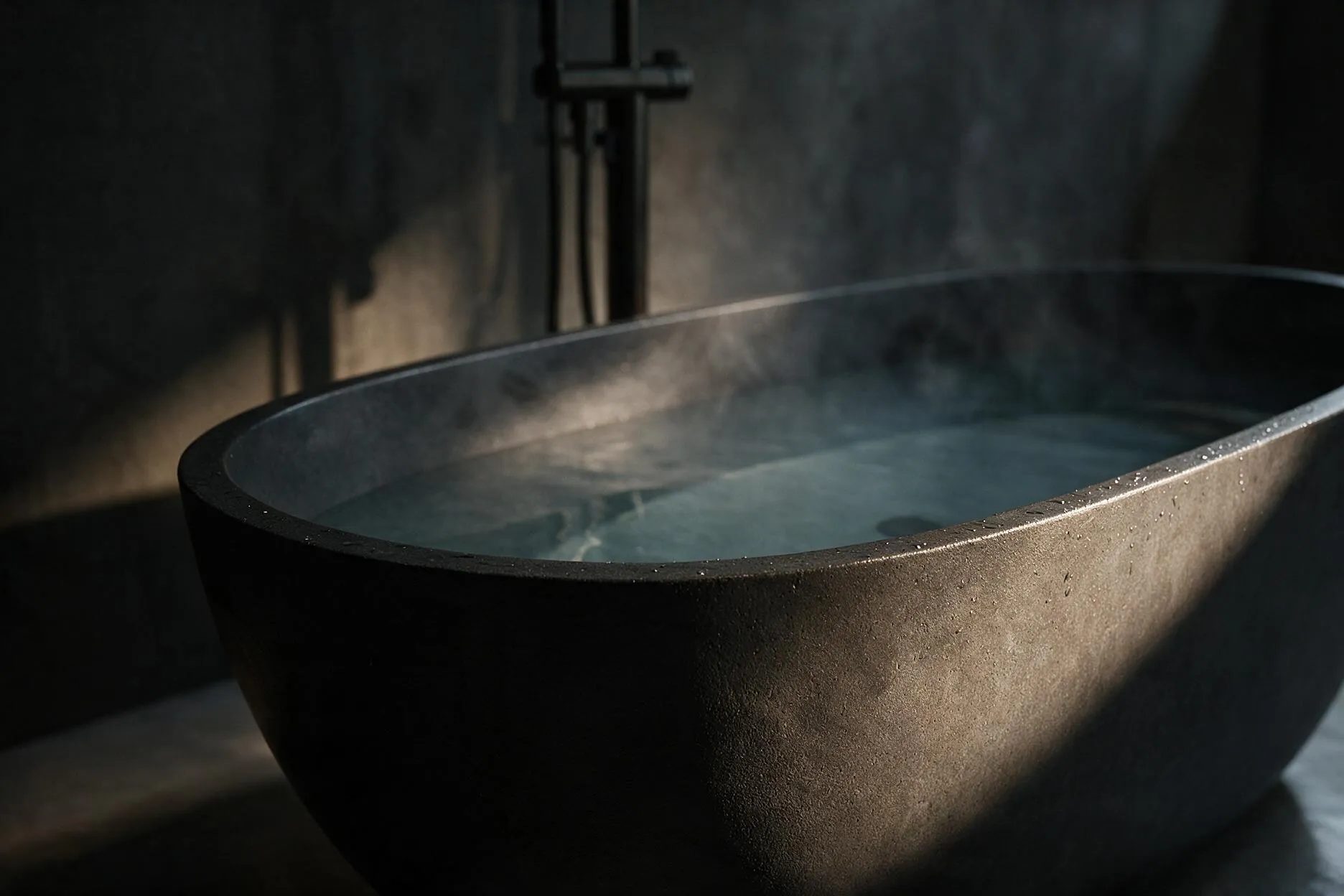
Sculptural baths take two opposite approaches: a solid, matte monolithic form like Onyx that absorbs light and reads through mass and stillness, or a translucent resin bath like Aquaire or Inferna that catches and holds colour, in blue or red. Both aim to stand alone in a room as sculpture that happens to hold water.
At one end of this is Onyx — a bath with real weight, matte black and monolithic, absorbing light rather than reflecting it. It doesn't ask to be noticed through colour. It asks through mass and stillness.
At the other end is Aquaire and Inferna — translucent resin baths that do the opposite, catching light and holding it, one in a fluid glass-blue, the other a molten red. Neither reads as a "coloured bath" in the decorative sense. They read as sculpture that happens to hold water.
Both approaches — the solid monolith and the luminous form — are answering the same brief: a bath that could stand in a room with nothing else in it and still look considered. That's the real test of a sculptural piece, in a bathroom or anywhere else. For the full range built around exactly this idea, our spa-style bath collection is worth a browse.
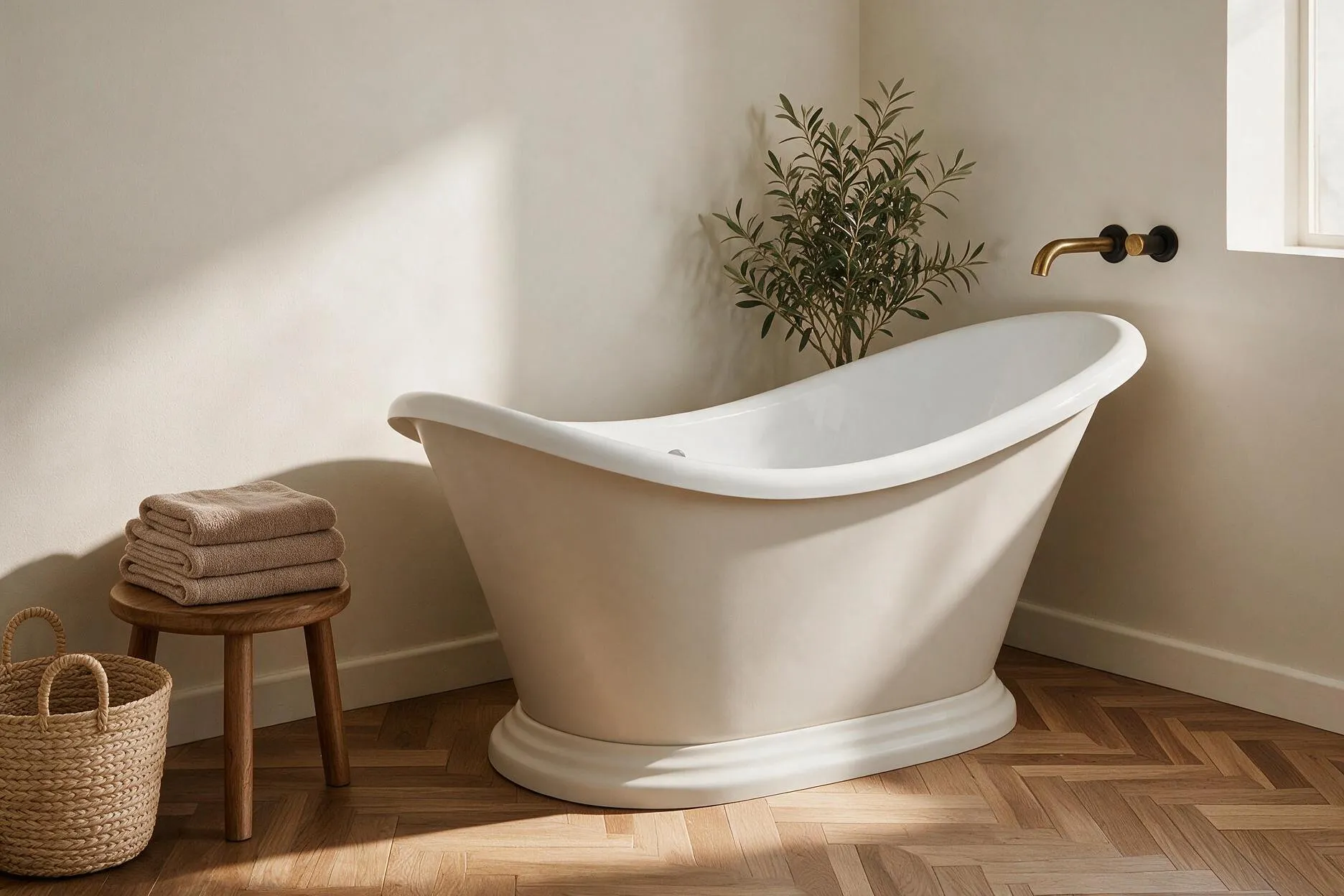
The assumption used to be that shape was a luxury only a large bathroom could afford — that anything smaller had to default to a plain rectangle. Isla and Reverie argue otherwise. Isla, at 1350mm, is the most compact bath in the range, built with a raised, slipper-inspired back so the interior works harder than the footprint suggests. Reverie takes a similarly modest 1500mm length and gives it real depth, built for a full recline rather than a perch.
Neither compromises on silhouette to save space. They're proof that a small bathroom doesn't have to mean a smaller design idea — just a more precisely considered one.
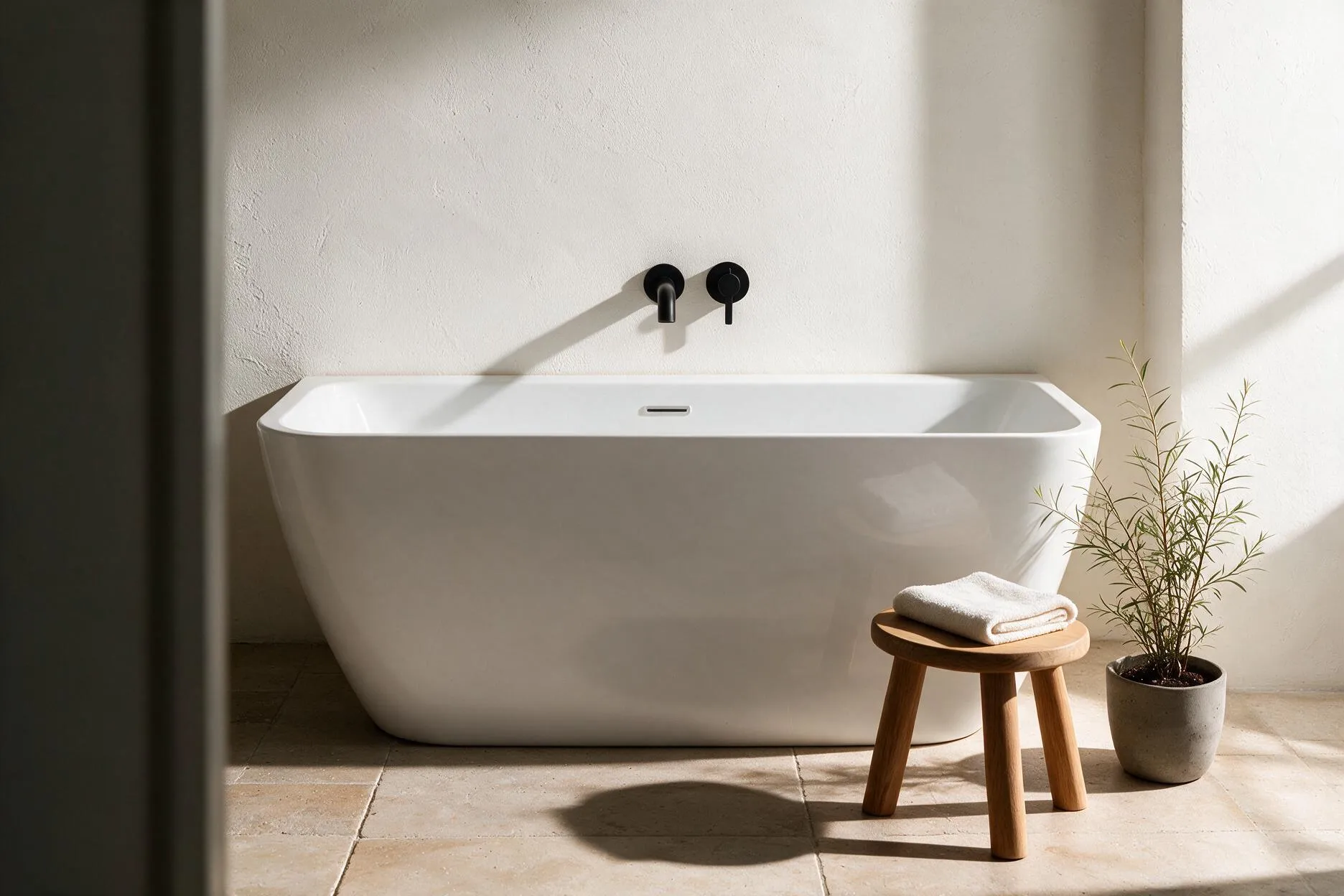
This section covers four sculptural shapes: Arête and Anse combine crisp, architectural edges with soft curves in flat-backed, back-to-wall silhouettes for space-efficient bathrooms, while Ondine takes a generous, classical roll-top form and Lune is a double-ended crescent curving at both ends.
The most interesting shapes in the range are the ones that refuse to pick a single language. Arête combines crisp, architectural edges with softened corners — sharp meeting soft in the same silhouette, built back-to-wall for a smaller, more contemporary bathroom. Anse does something similar from the opposite direction: a flat-backed D-shape that sits flush to the wall, with a curved front that keeps the softness a freestanding bath is chosen for in the first place. Both belong to a wider back-to-wall collection built for exactly this kind of considered, space-efficient shape.
For a room built around a more classical curve, Ondine takes the roll-top silhouette back to its roots — generous, drawn rather than manufactured — while Lune's double-ended crescent curves at both ends, so there's no fixed "right way" to sit in it. Seen together, the full freestanding bath range makes the point better than any single piece can: shape, not colour, is where the real decision is being made this year.
No — Isla and Reverie are both built to bring real shape and a proper soak to a compact footprint, at 1350mm and 1500mm respectively.
It's a question of intent. A sculptural bath is designed as a standalone form first — one that would hold its own in a room with nothing else in it — rather than a fixture finished in a trend colour or texture.
Arête and Anse are both built with a flat rear edge for a flush, back-to-wall position and wall-mounted taps, while keeping a distinct sculptural front.
No — every Elani bath needs a standard hot and cold water supply and a floor-mounted or freestanding tap, and we'd always recommend installation by a qualified plumber, the same as any freestanding bath.