How To Stop Limescale Marking Brushed Brass | Elani
Never use limescale remover on brass — it strips the PVD. What to use instead, and the thirty-second habit that stops marks forming in a hard water area.
August 24, 2026
4 minutes
Never use limescale remover on brass — it strips the PVD. What to use instead, and the thirty-second habit that stops marks forming in a hard water area.
August 24, 2026
Last updated 24 August 2026 · Elani Journal
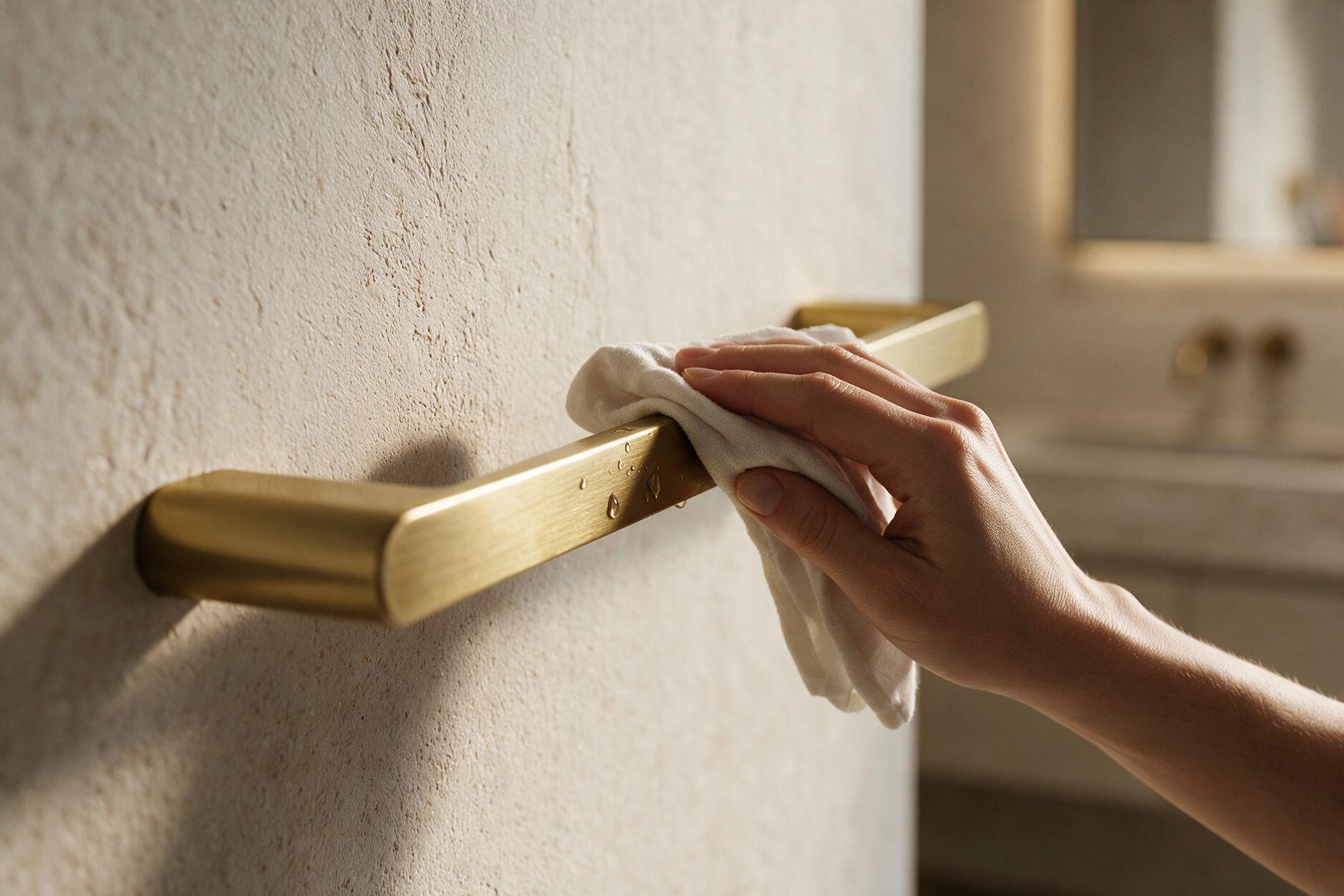
Wipe brushed brass dry after every use — that single habit prevents more limescale than any cleaning product. The marks form as hard water evaporates and leaves mineral deposits behind, not from anything wrong with the brass itself, and they show up more visibly against brushed brass's warm, textured surface than they would on plain chrome.
Brushed brass has a directional, slightly textured finish rather than a mirror-smooth one, which is exactly what gives it depth and warmth — the full case for the finish is in Brushed Brass Bathroom Ideas. That same texture gives mineral deposits somewhere to sit rather than sheet straight off, which is why limescale reads as a pale, chalky bloom on brushed brass in a way it wouldn't on gloss chrome. It's a visibility issue, not a durability one.
Most of the UK runs moderately to very hard water, and the single most effective prevention is simple — dry the tap or fitting with a soft cloth straight after use, before the water has time to evaporate and leave mineral residue behind. A pack of microfibre cloths from M&S or Sainsbury's, kept within reach, does the job. In particularly hard water areas, a water softener or a point-of-use filter reduces the mineral load reaching the fitting in the first place, though it's rarely necessary for most homes.
For limescale that's already formed, a 50/50 solution of warm water and lemon juice — a couple of lemons from any UK supermarket, Sainsbury's or Tesco both stock them cheaply — applied on cotton wool and left in contact for no more than 15–20 minutes will lift it. Brushed brass finishes — including Elani's Aurum collection — are a coated finish rather than solid metal, so keep contact time short and rinse thoroughly afterwards. Repeated long soaks are what wear a coating down, not the occasional short one.
Avoid bleach, harsh spray cleaners and rust removers entirely, and skip steel wool, scouring pads or an abrasive brush, all of which will scratch through the coating rather than clean it. If in doubt, warm water, a mild soap — Fairy from Asda is fine — and a soft cloth handles everyday cleaning without any risk at all. The same principle applies across finishes; see how we handle matte black for the equivalent care routine.
Most of England, particularly the south and east, has moderately hard to very hard water. If kettles and showerheads in your home need regular descaling, the same minerals are affecting your taps.
Yes — it reduces the calcium and magnesium that cause limescale at the source, which means less to wipe away and less risk of buildup even without perfect daily habits.
No. Limescale is a surface deposit that wipes or lifts away; tarnishing is a change to the metal's colour underneath. A genuine PVD brushed brass finish, like Elani's, resists tarnishing — see Does Brushed Brass Tarnish? for more on that distinction.
Not meaningfully — the textured finish shows limescale slightly more readily than smooth chrome, but the same dry-after-use habit prevents it just as effectively across any finish.
Aurum Towel Rail — Brushed Brass. Shop now →
Aurum Robe Hook — Brushed Brass. Shop now →
Aurum Soap Dispenser — Brushed Brass. Shop now →