For years, the defining quality of a good bath was how smooth and reflective it looked. That's shifting. Across UK bathroom design, tactile, textured finishes are overtaking flat gloss as the marker of a considered room — surfaces that reward touch as much as sight, and that catch light instead of just bouncing it back.
Elani has three baths built entirely around this idea, and each takes a different approach to the same trend.
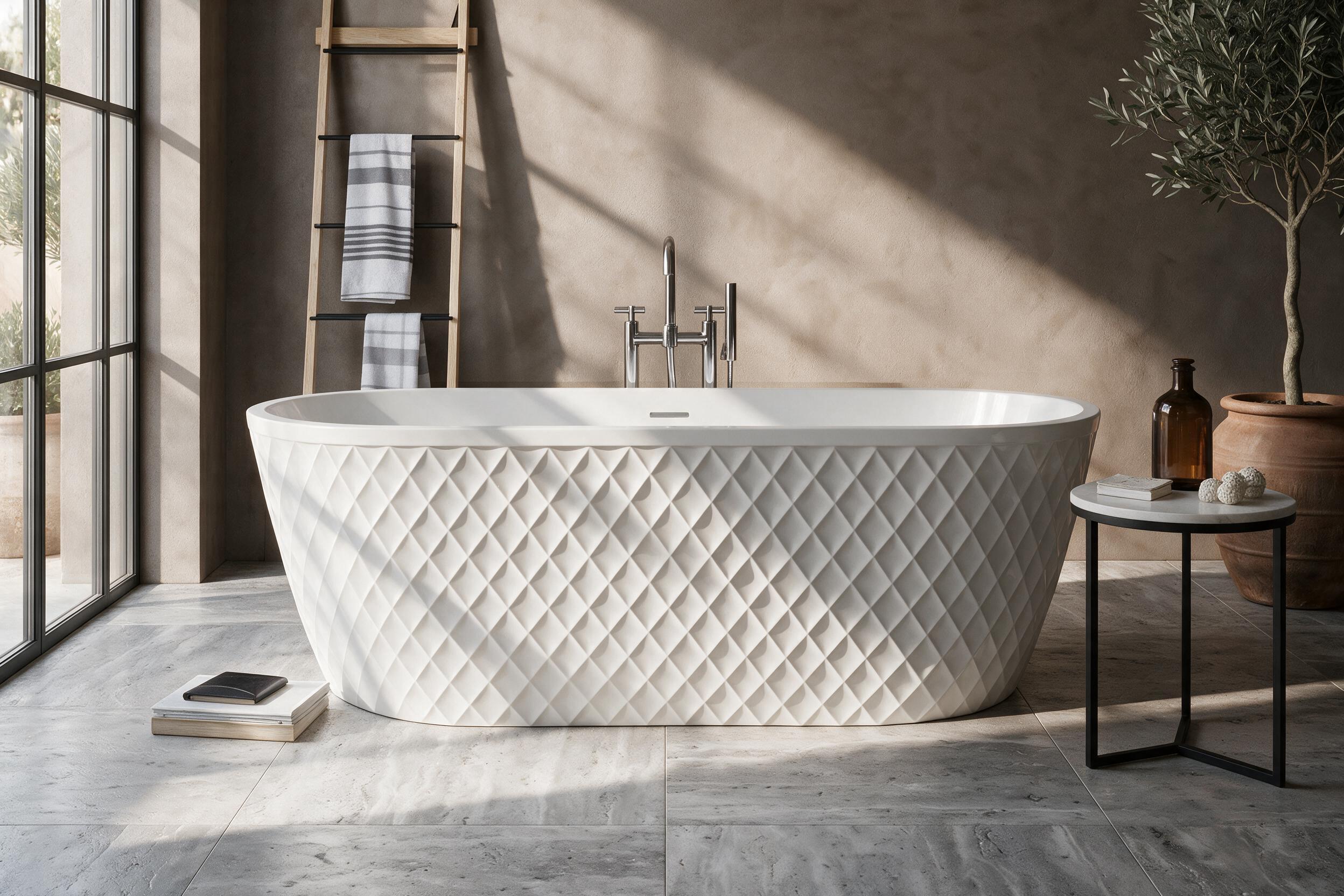
The Facet — geometry as the whole point.
Last updated 23 August 2026 · Elani Journal
Fluted — Vertical, Architectural, Familiar
The Reede brings deep, vertical grooves to a back-to-wall silhouette. It's the most established of the three textures in UK interiors — fluting has been showing up on kitchen cabinetry and furniture for several years before making its way to the bathroom — which makes it the safest entry point if you want texture without a statement that feels unfamiliar. The grooves catch light beautifully and add a real sense of height to the room.
Basket-Weave — Tactile, Warm, Unexpected
The Weave takes the opposite approach: an intricate, rhythmic basket-weave exterior that looks handcrafted even though every bath is precision-made. It's the texture most people want to touch before they've even asked what it's made from. In a room built around natural materials, it's the piece that ties everything together rather than standing apart from it.
Faceted — Bold, Geometric, Unmissable
The Facet is the most confident of the three — a diamond-textured exterior that turns the bath into a sculptural object in its own right. Where fluting and weave add texture to a fairly traditional silhouette, the Facet's geometry is the whole point: sharp, precise, and genuinely different depending on the angle and the light hitting it.
Which One Actually Suits Your Bathroom
If your room leans classic or transitional, Reede's fluting fits without dating the space. If you're building around warm, natural materials and want the bath to feel handmade, Weave is the more considered choice. If your bathroom can carry one genuinely bold statement piece, the Facet is built for exactly that role.
Frequently asked questions
Are textured baths harder to clean than smooth gloss baths?
Not meaningfully. All three are finished in the same 5mm sanitary-grade acrylic as Elani's smooth baths, and the exterior texture doesn't affect the bathing surface itself, which remains smooth. A standard non-abrasive bathroom cleaner is all any of them need.
Do textured baths cost more than smooth ones?
Not inherently — texture is a design choice, not a cost driver on its own. Price differences between baths come down to size, shape and manufacturing process rather than whether the exterior is textured or flat.
Which textured bath suits a small bathroom best?
Reede's back-to-wall, flush-fitting design is the most space-efficient of the three, since it sits directly against a wall rather than needing clearance on every side.
Can I mix textures in one bathroom — for example a textured bath with plain tiles?
Yes, and it's often the better choice. A textured bath is already a strong visual statement; pairing it with simpler, plainer tiling and fittings lets the bath's texture read clearly instead of competing with a busy tiled backdrop.
Read next: Is Fluted Bathroom Design Still A Trend In 2026? and The Sculptural Bath.