Brushed Brass vs Brushed Gold vs Antique Brass | Elani
Three names, three different things — and only one is a metal. What each finish actually is, how they age, and which one matches the fittings you already own.
October 6, 2026
5 minutes
Three names, three different things — and only one is a metal. What each finish actually is, how they age, and which one matches the fittings you already own.
October 6, 2026
Last updated 6 October 2026 · Elani Journal
Brushed brass and brushed gold are both PVD finishes in the same warm-metal family — brass is marginally cooler and browner, gold marginally warmer and lighter. Antique brass is different: a deliberately darkened, uneven finish meant to look aged. All three are usually a coating over a brass or stainless substrate rather than solid metal, and the naming is not standardised, so two manufacturers' "brushed brass" can be visibly different colours.
There is no industry standard for what counts as brushed brass versus brushed gold. One brand's brushed brass is another's brushed gold, and a third will call something close to both "champagne bronze". The names describe an intended colour, not a specification.
This matters when you are buying across brands, which almost everyone does — the tap from one supplier, the shower from another, the hooks from a third. Two pieces both labelled brushed brass can arrive noticeably different in tone, and there is no way to tell from a product page.
The practical answer is to buy the warm metalwork for one room from as few sources as possible, and to treat the colour as something you confirm in person or against a return policy rather than something the name guarantees.
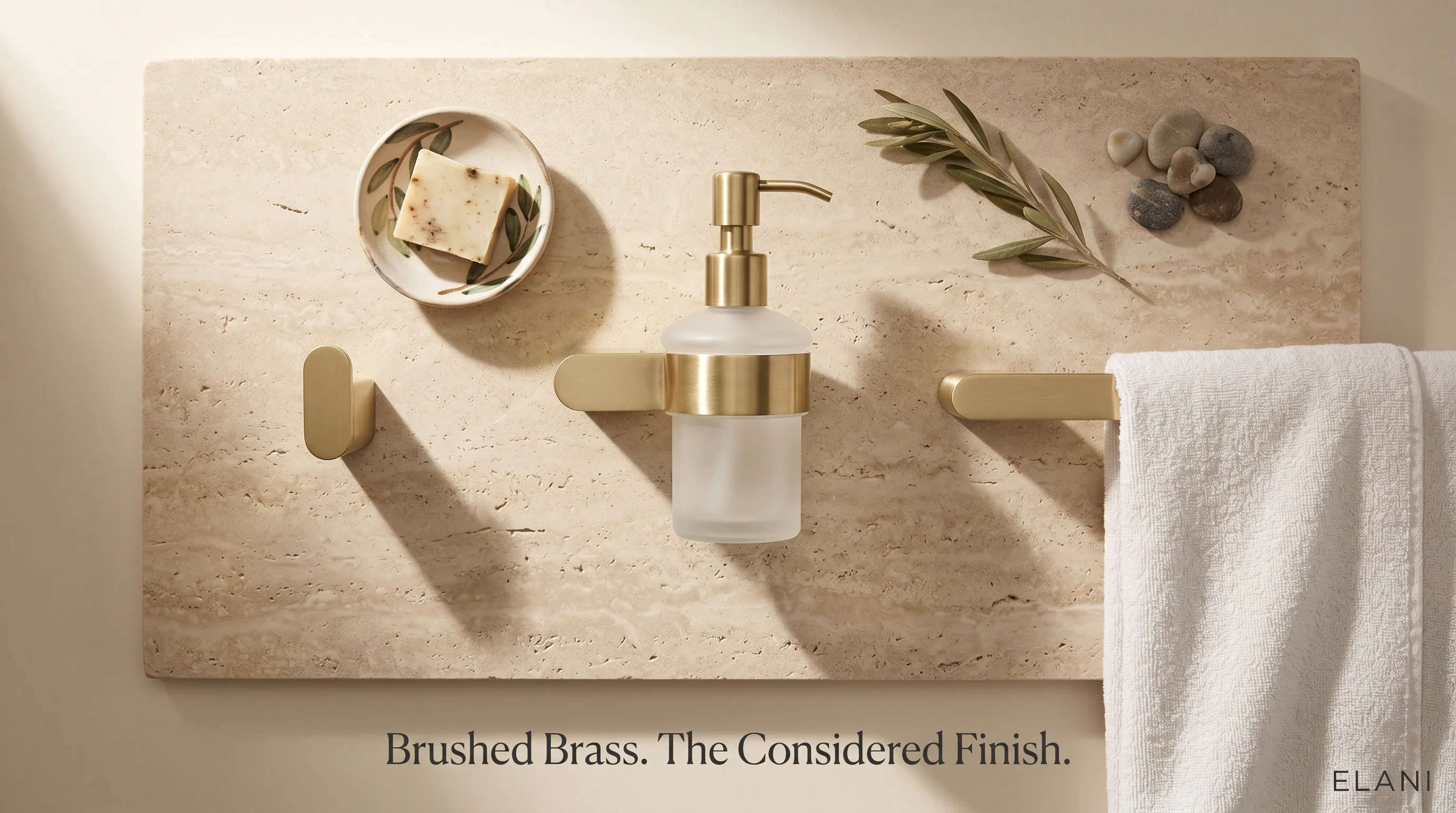
The cooler, browner end of the warm-metal range. Slightly muted, with a visible directional grain from the brushing process, and close enough to a neutral that it sits quietly in a room rather than drawing the eye.
On a good fitting, this is a PVD coating — physical vapour deposition, a layer bonded to the substrate inside a vacuum chamber rather than painted or plated on top. That is what makes it durable in a wet room; the full explanation is in Does Brushed Brass Tarnish?. Elani's Aurum Collection and the brushed brass Circa mirror use this finish.
Warmer and a shade lighter than brushed brass, with more yellow in it. In isolation most people cannot tell the two apart; side by side in the same room, the difference is obvious and unflattering to both.
Brushed gold reads as slightly more decorative. It flatters a warm scheme — travertine, clay, oak — and can look brash against cool grey. Elani's warm-metal taps are finished in brushed gold: the Vermeil basin tap and the Doré floorstanding bath filler.
⚠️ Worth being clear about, since it is a question we get: brushed gold and brushed brass are close but not identical. If you want a single unbroken tone across taps and accessories, buy the taps and the hooks as one decision rather than assuming the two names match.
The outlier. Antique brass is finished to look aged — darkened in the recesses, lighter on the raised edges, deliberately uneven. It is a period finish, at home with traditional crosshead taps, roll-top baths and Victorian-style sanitaryware, and it looks out of place against flat-fronted contemporary fittings.
Two things to know before buying it. First, the unevenness is applied, not earned, so it will not develop further — an antique brass fitting looks the same in year ten as it did on day one. Second, because the effect depends on variation, two antique brass pieces from different makers will almost never match. If you want the look, buy the whole room from one range.
A genuine PVD finish — brushed brass or brushed gold — does not tarnish. The coating is bonded at a molecular level, so what people read as tarnishing is nearly always limescale sitting on the surface, which wipes off. Lacquered and electroplated finishes are a different matter: the top coat thins with cleaning and steam, and once it goes, the brass underneath darkens exactly as untreated brass would.
Unlacquered solid brass — rare in bathroom fittings, more common in kitchen taps and door hardware — is the one finish that genuinely patinates, going from bright yellow to deep brown over a few years. Some people buy it for exactly that. It is not what you are getting when a product page says brushed brass.
For maintenance across all three, the routine is the same and it is short: soft cloth, warm water, dry after use, and never a limescale remover. The detail is in How To Prevent Limescale Marking Brushed Brass.
If the room is cool-toned — grey stone, white tile, black fittings — brushed brass is the safer choice, because its slight coolness keeps it from looking stuck on. If the room is warm — travertine, limestone, oak, clay plaster — brushed gold has more to work with.
If the bathroom is period, or the sanitaryware is traditional, antique brass is the only one of the three that will look right, and you should buy it as a complete set.
And if you already own one warm-metal piece and are adding to it, match to the piece rather than to the name on the box. For how to build the rest of the room around whichever you choose, see Brushed Brass Bathroom Ideas and the accessories buying guide.
No, though they are close. Brushed brass is marginally cooler and browner; brushed gold is warmer and lighter with more yellow in it. In separate rooms nobody would notice. In the same room, side by side, the mismatch is visible — so pick one and stay with it.
No. Antique brass is deliberately darkened and uneven to imitate age, while brushed brass is a consistent satin tone. They belong to different design languages — antique brass suits traditional and period bathrooms, brushed brass suits contemporary ones.
Not reliably. There is no standard definition of the colour, so two manufacturers' brushed brass can differ noticeably. Buy the warm metalwork for one room from as few sources as you can, and check in person where possible.
A genuine PVD brushed gold finish does not tarnish — the coating is bonded to the metal rather than applied on top. Plated or lacquered gold finishes can dull and discolour over a few years in a steamy bathroom, which is the main reason to check how a fitting is finished before buying on price.
Neither commands a premium over the other — the cost difference between fittings comes from the quality of the underlying brassware and whether the finish is genuine PVD, not from which of the two colours you pick.
Better not to. They are close enough that the difference reads as a mistake rather than a contrast. If you want two warm-metal tones in one room, the stronger pairing is brushed brass with a genuinely different finish such as matte black or brushed gunmetal.
Vermeil Basin Tap — Brushed Gold. Shop now →
Doré — Floorstanding Bath Filler, Brushed Gold. Shop now →
Aurum Towel Rail — Brushed Brass. Shop now →