Warm Neutral Bathroom Ideas — Travertine, Stone & Soft Plaster | Elani
Wet rooms trade the enclosure for one open, level surface. How to plan the fall, the tanking and the finish — and whether it suits your space.
July 30, 2026
5 minutes
Wet rooms trade the enclosure for one open, level surface. How to plan the fall, the tanking and the finish — and whether it suits your space.
July 30, 2026

Last updated 23 August 2026 · Elani Journal
"Neutral" has a branding problem. Said out loud, it sounds like the safe choice — magnolia walls, beige tile, a bathroom designed to offend no one and excite no one either.
That is not what a warm neutral bathroom is. Done properly, it is one of the hardest palettes to get right and one of the most rewarding when it lands: travertine with visible mineral veining, plaster with real texture, timber with grain, metal with a warm cast. Every material earns its place by having depth up close, even though the overall effect from across the room is calm.
Here is how the palette actually works, material by material.
The difference is texture, not colour. A beige bathroom is flat — the same smooth, matte surface repeated across tile, wall, and fixture, with colour doing all the work and falling short. A warm neutral bathroom uses materials with genuine variation within a narrow tonal range: travertine's natural pitting and veining, limewash plaster's soft cloud-like texture, oak's visible grain.
Stand close to a well-built warm neutral bathroom and every surface has something going on. Stand back, and it reads as one calm, cohesive room. That combination — quiet from a distance, detailed up close — is the actual definition of quiet luxury, and it's why the palette photographs so well and lives so well at the same time.
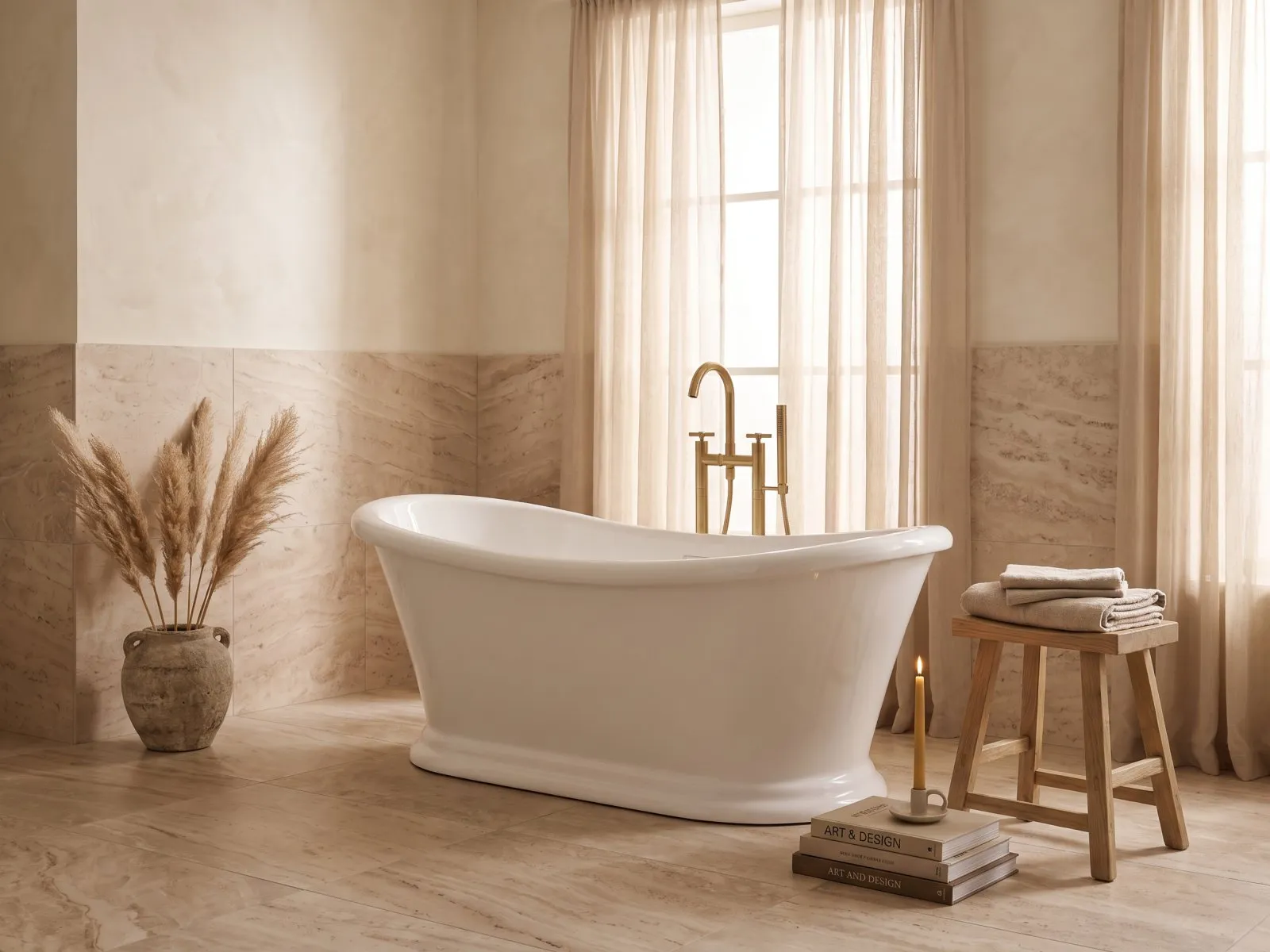
The warm neutral palette is built from four materials: travertine stone for the floor and wet walls, limewash plaster for texture on drier walls, aged or light oak for warmth underfoot, and warm metal hardware such as brushed gold or brass rather than cold-toned chrome.
Travertine. The foundation. Its natural pitting and fossil-like veining give it a warmth and depth that porcelain trying to imitate it never quite achieves. Large-format travertine tile, laid with minimal grout lines, is the single highest-impact material choice in this palette — it does more visual work than anything else in the room.
Limewash plaster. Where travertine is the floor and the practical wall surface, limewash plaster is where the warmth lives on the walls that don't need to be waterproofed to shower-height. It has a soft, cloud-like texture that flat paint cannot replicate — the way it catches light changes throughout the day, which is exactly the quality a photograph struggles to capture and a room lives with beautifully.
Aged or light oak. Timber flooring or timber accents — a stool, a shelf, a vanity unit — bring warmth underfoot and an organic material against all the stone. Light, slightly textured oak works better here than a dark, glossy timber, which pulls the palette toward heavier and more traditional territory.
Warm metal hardware. This is where the palette either completes itself or falls apart. Chrome reads cold and clinical against travertine and plaster — it's the one material in this list that actively fights the warmth everything else is building. Brushed gold or brushed brass hardware, by contrast, sits inside the same warm tonal family as the stone and plaster around it, rather than interrupting it.
Building the room means choosing a white or pale freestanding bath as the centrepiece, a brushed gold floorstanding filler for the tap, matching brushed gold hardware and accessories throughout, and layering in texture — a waffle-weave towel, a woven basket, a stack of books — to keep the space feeling lived-in rather than showroom-staged.
The bath. A white or pale stone-toned freestanding bath is the natural centrepiece — the Crest, with its classic slipper silhouette, sits particularly well against a travertine and limewash backdrop, its rolling curves softening a room built mostly from straight lines and flat planes.
The tap. Brushed gold is the definitive finish here. The Doré floorstanding filler, in genuine brushed gold PVD, holds its warm colour in a wet environment in a way that plated alternatives simply don't — a real consideration in a room designed to be lived in for a decade, not photographed once.
Hardware and accessories. Consistency matters more here than in almost any other palette, because warm neutral has so little colour contrast to hide a mismatched finish. The Aurum Towel Rail, Aurum Soap Dispenser, and Aurum Robe Hook all share the same brushed gold PVD finish for exactly this reason — one decision, carried through every touchpoint in the room.
Layering texture. Once the hard materials are in place, the detail that makes a warm neutral bathroom feel finished rather than showroom-staged is texture layering: a waffle-weave towel, a woven storage basket, a stack of hardback books, a dried pampas or eucalyptus stem in a stone vessel. These add the "lived-in" quality that a room built entirely from hard, polished surfaces can otherwise lack.
Going too flat. The palette's biggest risk is that every material chosen for its subtlety adds up to a room with no focal point at all — technically warm, technically neutral, but visually inert.
The fix is contrast of texture, not colour. A rippled or fluted bath exterior against a smooth plaster wall. A knurled tap dial against a flat stone basin. Matte plaster against the natural sheen of brushed gold. None of these introduce a new colour to the room — they introduce a different way of catching the same warm light, which is what keeps a neutral palette from reading as beige.
A warm neutral bathroom builds its colour scheme from materials with natural warmth and texture — travertine stone, limewash plaster, light oak, and warm metal hardware like brushed gold or brass — rather than from paint colour alone. The warmth comes from material choice and texture variation, not from adding beige or tan pigment to flat surfaces.
Choose materials with genuine texture and variation rather than flat, uniform surfaces — travertine's natural veining, limewash plaster's soft texture, visible timber grain. Then layer in contrast through form and finish rather than colour: a fluted or rippled bath against a smooth wall, a knurled tap against a flat basin. Flatness, not neutrality, is what reads as boring.
Travertine is porous and benefits from being sealed on installation and re-sealed periodically — typically every 1–2 years in a wet environment — to resist staining and etching from acidic products. With sealing maintained, it performs well in bathrooms and is a common choice in both period and contemporary UK homes.
Brushed gold or brushed brass, without much competition. Both sit within the same warm tonal family as travertine and limewash plaster, extending the palette rather than interrupting it. Chrome and other cool-toned metals read visibly colder against these warm stone and plaster tones and tend to fight the rest of the room rather than complete it.
Yes, when applied correctly and kept away from direct, sustained water contact — it's best suited to walls outside the direct shower splash zone, with tile or a sealed surface used in the wet zone itself. Limewash is breathable, which actually helps manage humidity in a bathroom better than some sealed paint finishes, and it develops a soft patina over time rather than showing wear as damage.
Leaning toward colour instead of neutral? See Are Blue Bathrooms The Next Big Colour Trend?