Small Bathroom Ideas — The Elani Guide
A small bathroom doesn't need a smaller idea — it needs a back-to-wall bath, a wall-hung basin, and one statement piece. How to plan it.
August 24, 2026
5 minutes
A small bathroom doesn't need a smaller idea — it needs a back-to-wall bath, a wall-hung basin, and one statement piece. How to plan it.
August 24, 2026
Last updated 24 August 2026 · Elani Journal
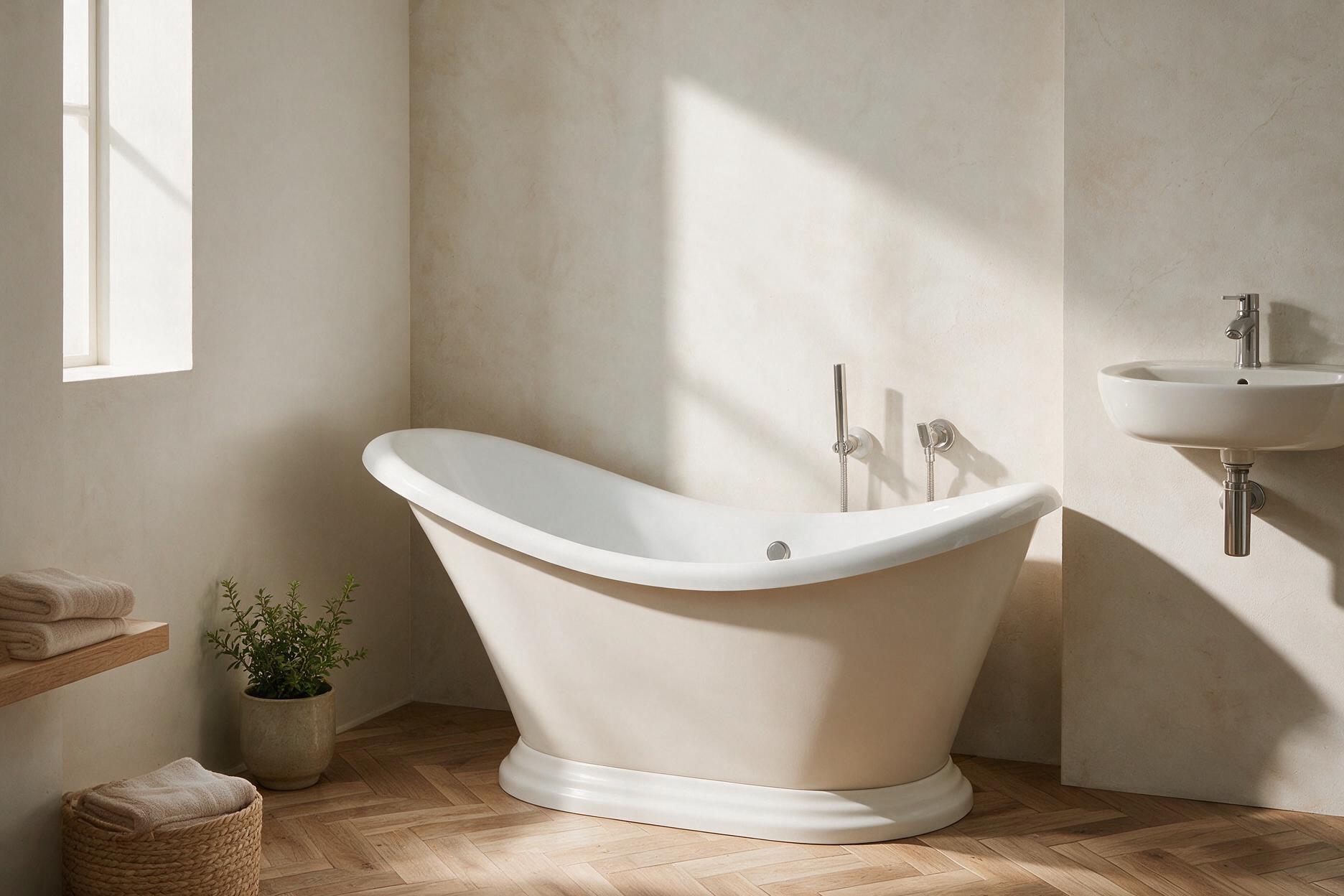
A small bathroom works best with a back-to-wall bath rather than a fully freestanding one, a wall-hung basin to keep the floor visually open, and one considered statement piece rather than several competing for attention. Elani's Isla, at 1350mm, and Reverie, at 1500mm, are both built specifically to bring real shape to a compact footprint rather than scaling down a design meant for a bigger room.
In a small bathroom, the bath is the single decision that constrains everything else, so it has to come first — the full sizing logic is in Freestanding Bath Ideas. A back-to-wall bath — sitting flush against one wall rather than needing clearance on all sides — is almost always the right call under roughly 4m², since it recovers the floor space a fully freestanding bath would need on every side. Isla and Reverie are both built around exactly this brief: Isla's raised, slipper-inspired back means the interior works harder than its 1350mm footprint suggests, while Reverie's 1500mm length still gives room for a full recline rather than a perch.
A wall-hung basin does more for a small bathroom than almost any other single choice, because it removes the vanity unit's footprint from the floor entirely and lets the eye read more open space than is actually there — see Basin Ideas for the full comparison. It's a smaller change than swapping the bath, but often the one that makes the room feel noticeably less cramped day to day.
The instinct in a small room is to simplify everything, but that tends to produce a bathroom with no real focus at all. The better approach is to restrain almost everything — wall colour, tiling, hardware — around one considered piece, whether that's a shaped bath like Isla, a strong mirror, or a single striking tap finish. A back-to-wall bath in a considered shape, like Elani's Arête or Anse, gives a small room exactly this kind of focal point without needing the floor space a fully freestanding piece would demand.
Beyond their obvious function, a well-placed mirror reflects available light back into the room, which matters more in a small bathroom than a large one, where natural light is often already generous. Elani's Circa, in either brushed brass or matte black, is sized to do this without dominating a compact wall the way an oversized mirror can.
Once the bath, basin and mirror are settled, storage is the last real decision — and it's the one most likely to compromise the room if it's an afterthought. Wall-mounted, considered accessories — Elani's Aurum collection or the matte black Edge set — do the job of open shelving without the visual clutter a freestanding unit adds in a room that can't spare the floor space.
Isla, at 1350mm — the most compact bath in the range, built with a raised slipper-inspired back so the interior still feels generous despite the shorter footprint.
Back-to-wall, in almost every case under 4m². It needs clearance on only three sides rather than four, which is usually the difference between a bath fitting comfortably and one that doesn't fit at all.
Yes, more often than people expect — a considered dark scheme with good lighting and a well-placed mirror can feel enveloping rather than cramped. The risk isn't the colour; it's poor lighting paired with it.
A practical minimum of 600mm on any side that needs access. A back-to-wall bath only needs this on three sides rather than four, which is exactly why it suits a small room better than a fully freestanding one.
Isla — most compact freestanding bath, 1350mm. Shop now →
Reverie — 1500mm, built for a full recline. Shop now →
Circa — round mirror, brushed brass or matte black. Shop now →
Browse the full Small Bathroom Bath Collection.