Sliding, Pivot, Bi-Fold Or Quadrant? A UK Guide | Elani
Your room decides the format, not your taste. How many walls and how much floor you have narrows four shower enclosure types down to one.
September 21, 2026
5 minutes
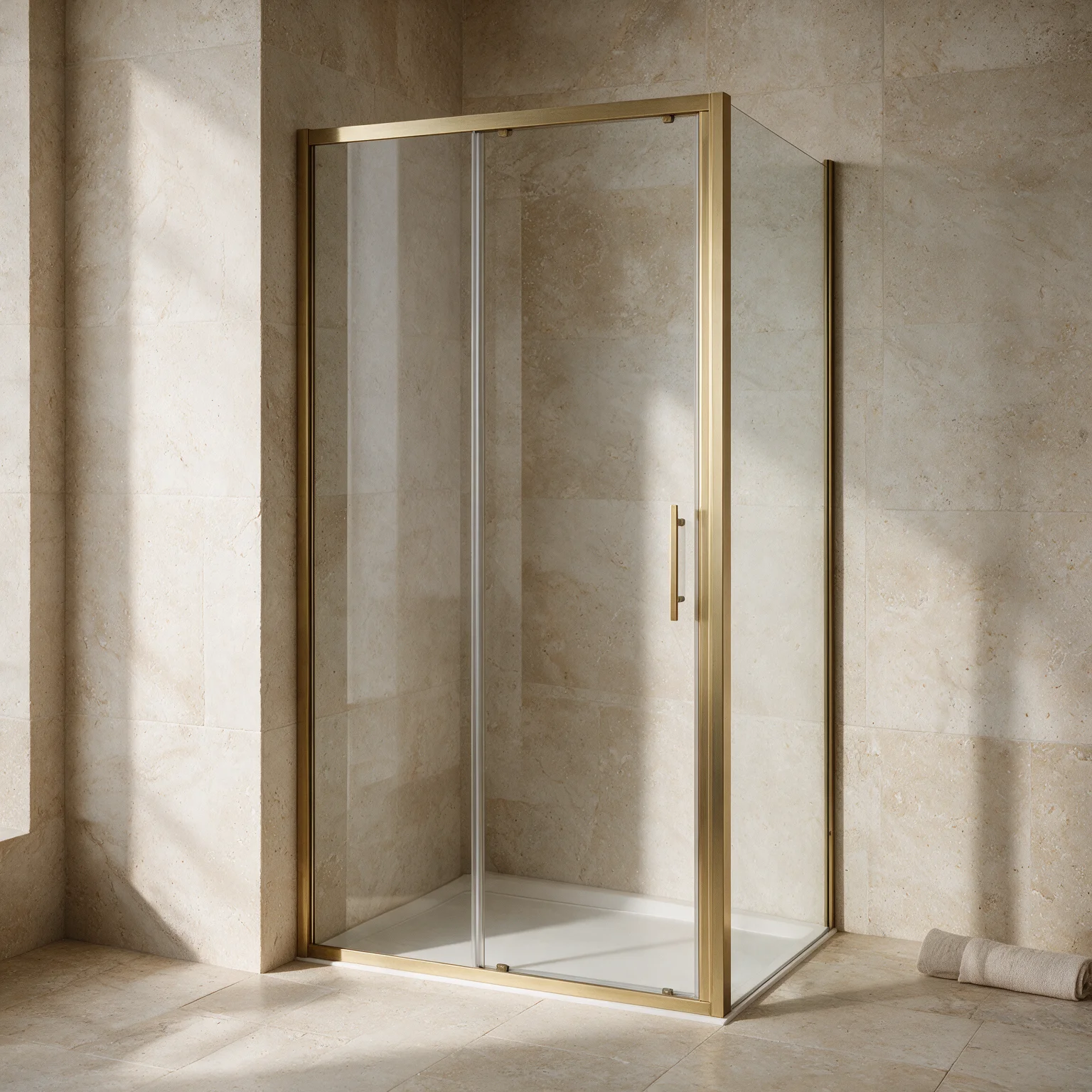
Your room decides the format, not your taste. How many walls and how much floor you have narrows four shower enclosure types down to one.
September 21, 2026
Most people choose a shower enclosure by finding a look they like and then trying to make it fit. It is the wrong order. The format — sliding, pivot, bi-fold or quadrant — is decided almost entirely by two facts about your room, and once you know them the choice narrows to one or two options. Everything after that is finish and size.
Featuring the Elani enclosure range.
Last updated 21 September 2026 · Elani Journal
This one question eliminates most of the range.
Three walls — a recess or alcove, with only the fourth side open. You need a single door and nothing else: a pivot door or a bi-fold.
Two walls — a corner. You need a door plus a returning side panel, or a curved quadrant that does both jobs in one: a sliding enclosure or a quadrant.
One wall, or none — an open wet room. A single fixed walk-in panel, with no door at all.
It is worth being deliberate here, because product photography routinely shows a door and a side panel together while the listing sells only the door. Check what is actually included before you order — a recess door bought for a corner shower will not enclose it.
A door has to go somewhere when it opens. In a bathroom of any decent size this is a non-question. In a small ensuite it decides everything.
Stand where the shower will be and look at what is opposite it. A basin, a WC, a towel rail or the room door within about 700mm of the opening rules out anything that swings outward. That is not a comfort judgement — it is the difference between a door that opens and one that hits something.
If the floor in front is clear, you have every option. If it is not, you have two: a bi-fold or a sliding enclosure.
A pivot door turns on a pin at the top and bottom rather than hanging off hinges on the frame. The practical effect is that the door carries its own weight on the pin instead of being pulled sideways every time it is used, so it stays true for longer, and it opens wider than a hinged door of the same width.
It is the simplest thing you can put in a recess and usually the least expensive. The cost is floor: it needs roughly 700mm of clear space in front to open comfortably.
Elani's is the Battant, in 6mm toughened glass at 1850mm tall, from £230.
A bi-fold splits down the middle and folds in on itself rather than swinging out. It needs almost no floor in front, which in a small ensuite is frequently the only reason it gets chosen — and frequently the only door that fits.
The trade is a second vertical edge to wipe where the two panes meet, and a hinge that benefits from being rinsed under the shower occasionally so limescale does not build in it. Neither is onerous, but they are real.
Elani's is the Pliant, 6mm glass at 1850mm, from £260.
A sliding enclosure runs the door along its own line on a concealed roller track. Nothing swings, so the floor in front of it stays usable — which in a family bathroom where the enclosure faces the basin is often the difference between a layout that works and one that does not.
Sliding mechanisms are more complex than a pivot, and across the UK market they cost more accordingly. What you get for it is a complete enclosure rather than a single door: the sliding front and the fixed side panel that returns to the wall.
Elani's is the Coulisse, from £425, which includes the door, the side panel, both wall profiles and the fixing pack. The tray is separate.
A quadrant curves between the two walls instead of meeting them at a hard edge, so the enclosure returns its corners to the floor and there is nothing to catch a hip on walking past. Twin doors slide apart from the centre, which means the opening is in the middle where you actually stand and neither door needs floor in front of it.
Two things to know. It needs a matching quadrant tray of the same radius — not a rectangular one, and 500mm and 550mm radii are both common in UK bathrooms and are not interchangeable. And the curve does take some internal space compared with a square enclosure of the same wall dimensions. That is the trade for the floor it gives back.
Elani's is the Arc, from £290, square at 800 x 800 and 900 x 900 or offset where one wall is longer.
A single fixed panel, no door, no track, nothing to collect limescale. It suits a wet room or a long run where the shower does not need closing off, and it is the quietest of the five to look at because there is no frame drawing a box around the shower.
The honest limitation is spray. Without a door, water reaches further into the room, which is why a return panel matters if the shower sits near a basin or a doorway.
Elani's is the Voile — 8mm glass at 1950mm, taller than the rest of the range, from £395, with an optional 300mm return.
Every format gives something up. Briefly, and without the marketing:
Pivot needs floor. Bi-fold has an extra edge and a hinge to keep clean. Sliding has a track, and a track is a thing to wipe. Quadrant is smaller inside than its wall dimensions suggest. Walk-in lets spray travel.
None of these is a reason not to buy a given format. They are the questions to ask yourself before you do, so that the one you choose is the one you would still choose in two years.
Once the format is settled, the size question is not the one most people expect. A shower door's headline size is not the size of the opening it fits — an 800mm door fits an opening somewhere between 740mm and 800mm, because the wall profile carries adjustment. Getting that wrong is the single biggest cause of a returned enclosure.
It has its own guide: What Size Shower Door Do I Need?
A bi-fold, in most cases. It folds inward on itself and needs almost no floor in front, so it works opposite a basin, a WC or a doorway where a pivot door would be unusable. If the shower is in a corner rather than a recess, a sliding enclosure does the same job — nothing swings, so the floor stays usable.
Neither is better; they answer different rooms. A pivot suits a three-walled recess with clear floor in front and is usually less expensive. A sliding enclosure suits a corner, or any room where the floor in front of the shower is needed for something else. If you have the space, a pivot is the simpler mechanism.
Only if your shower has two walls rather than three. In a recess the door closes the opening on its own. In a corner you need either a door plus a returning side panel, or a quadrant enclosure that curves between the two walls.
Six to eight millimetres of toughened safety glass is the sensible baseline for a door. Thicker glass is flatter and steadier, and it is why fixed walk-in panels are often 8mm — there is no frame holding them straight. Below 6mm the glass starts to rely on the frame rather than the other way round.
Around 1850mm for a door or enclosure, which is slightly shorter than a standard internal doorway and roughly three-quarters of the way up a 2400mm ceiling. Fixed walk-in panels are often taller — 1950mm in the case of the Voile — because the extra height is what makes a small room read as taller rather than tighter.
Next: work out the size with What Size Shower Door Do I Need?, budget it with How Much Does A Shower Enclosure Cost?, or if you are still deciding on the room itself, read Wet Room Or Walk-In Shower and Small Bathroom Ideas.