Black And Brass Bathroom Ideas — The 70/30 Rule | Elani
Black and brass works when one finish leads and the other accents. Which pieces go in which finish, the ratio that keeps it calm, and the pairing to avoid.
October 6, 2026
5 minutes
Black and brass works when one finish leads and the other accents. Which pieces go in which finish, the ratio that keeps it calm, and the pairing to avoid.
October 6, 2026
Last updated 6 October 2026 · Elani Journal
Black and brass works when one finish leads and the other accents — roughly 70% of the metalwork in one finish, 30% in the other. Split them evenly and the room reads as indecisive rather than designed. The usual division is matte black on the large, fixed pieces (taps, shower, bath) and brushed brass on the small, handled ones (hooks, rail, mirror frame), though it works just as well reversed.
Most finish combinations fail because the two metals are competing on the same terms. Chrome and brushed brass is the classic example — one is mirror-bright, the other is satin, and the eye reads the difference as a mistake rather than a choice.
Black and brass avoids that because neither finish is reflective. Matte black absorbs light, brushed brass diffuses it. They sit in opposite tonal families — one cool and recessive, one warm and advancing — without either one shining. That shared matte quality is what makes the contrast read as deliberate. It is the same logic behind pairing brushed brass with limewash walls or matte black with travertine.
A bathroom with half its metalwork in black and half in brass looks unresolved. Not because the finishes clash, but because nothing is leading — the eye has no idea which one is the scheme and which is the accent.
The working ratio is closer to 70/30. One finish carries the room; the other appears two or three times and stops. In practice that means picking a side early:
Black-led. Matte black taps, shower, towel ring and waste. Brass appears only on the mirror frame and a robe hook or two. This is the easier version in a small or dark bathroom, because black fittings disappear against a dark wall and the brass does all the lifting.
Brass-led. Brushed brass taps and accessories throughout, with matte black reserved for the mirror frame, the shower screen profile, or a black bath. This is the warmer version and it suits a light, stone-toned room better.
What does not work is alternating — black tap, brass hook, black rail, brass mirror. That is not a 50/50 split, it is noise.
The most reliable division is by permanence. Put the finish you are most confident about on the things that are hardest to change, and the other on the things you can unscrew in ten minutes.
Taps, shower valves and bath fillers are plumbed in. Changing one later means a plumber, so these should carry the lead finish — the one you are certain about. Elani's matte black Sable basin tap and Noir bath filler cover that side; the brushed gold Vermeil and Doré cover the other.
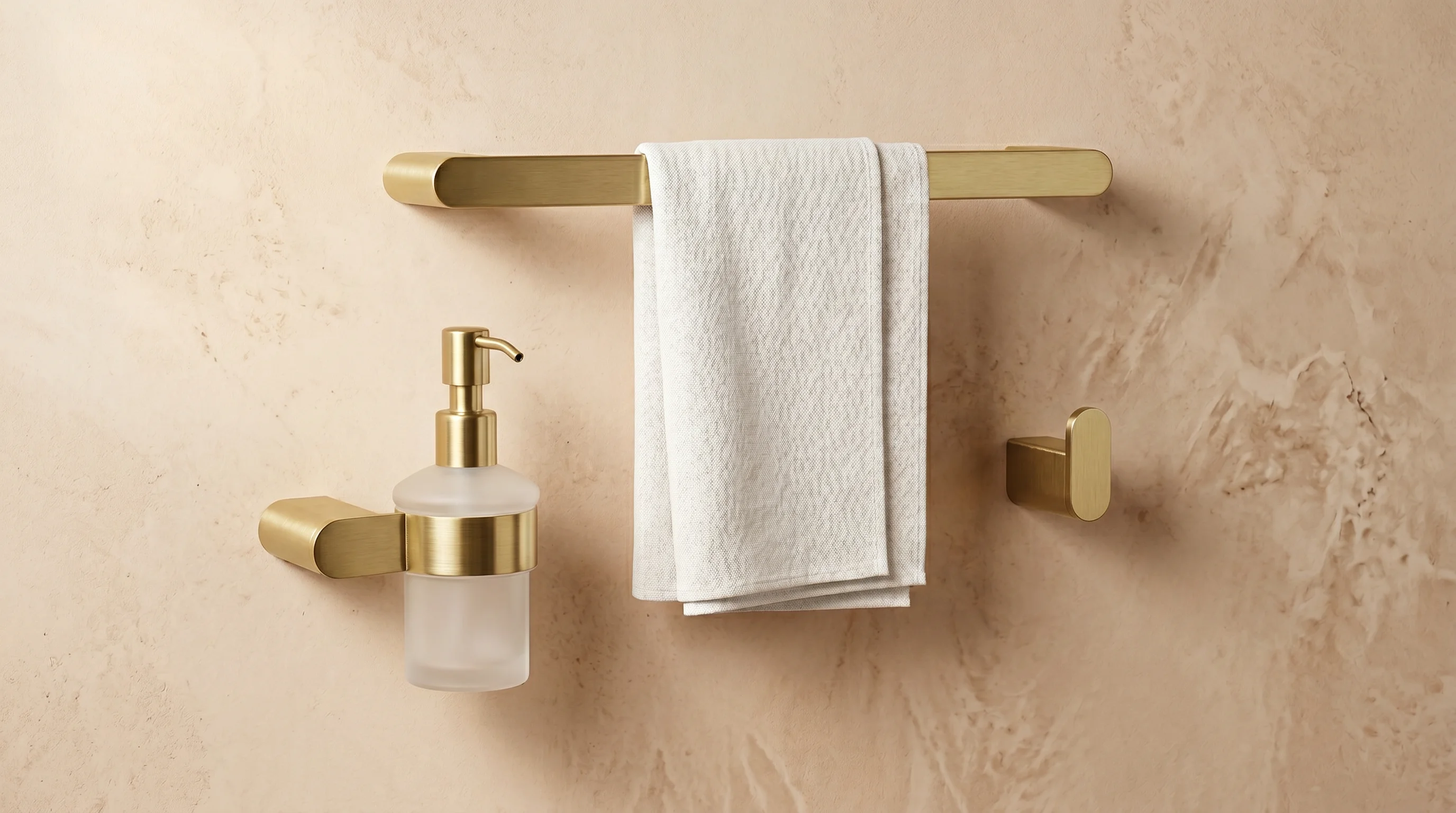
Hooks, towel rails, soap dispensers and mirror frames are surface-mounted. These are the accent finish, because if you change your mind the cost is a screwdriver and an afternoon. The Aurum Collection in brushed brass and the Edge set in matte black are designed to be the swappable layer rather than the committed one.
The mirror is the one piece that can go either way, which is why it is the best place to test a scheme. The Circa comes in both brushed brass and matte black — hanging the accent-finish version above a lead-finish basin is the cheapest way to see whether a pairing holds before you commit the plumbing.
Both finishes on one object. A black tap with a brass lever, a brass rail on black brackets. On a single piece of hardware, two finishes read as a manufacturing compromise rather than a design decision. Keep each object in one finish and let the contrast happen across the room.
Black grout as a third finish. Black grout plus black fittings plus brass accents is three visual systems in a small space. If the fittings are black, let the grout be neutral.
Forgetting the shower screen. The profile on a shower enclosure is a large piece of exposed metalwork that people plan last and then regret. Enclosures like the Coulisse come in matte black, chrome and brushed brass — pick the frame finish at the same time as the taps, not after the tiling is done.
Under-lighting it. Matte black absorbs light and brushed brass needs light to show its warmth. In a dim bathroom the brass goes brown and the black goes flat. Warm, layered lighting is not optional with this pairing.
If you are not yet sure, start on the accent side. A brushed brass robe hook (£29) and soap dispenser (£49) in an otherwise black bathroom is about £78 to find out whether you like living with the combination. That is a far better test than a mood board.
For how to sequence the rest, see How To Accessorize A Considered Bathroom, and for what the brass fittings themselves should cost, Bathroom Tap Prices Explained.
Yes, and it is one of the few finish pairings that reliably works. Both are non-reflective, so the contrast reads as deliberate rather than accidental. The rule is that one finish should lead and the other should accent — roughly a 70/30 split of the visible metalwork — rather than splitting the room evenly between them.
Whichever finish you are more confident about, because taps are plumbed in and the hardest to change later. The accent finish belongs on hooks, rails and the mirror frame, which can be unscrewed and swapped in an afternoon if you change your mind.
Yes, but lead with black and accent with brass rather than the reverse. Black fittings recede against a wall, so a small room with black taps and two or three brass pieces feels calmer than one with brass everywhere. Good lighting matters more in a small black-and-brass bathroom than in a large one.
Warm off-white, soft plaster, sand and clay tones all work, because they give the brass something to be warm against. Cool blue-greys are the weakest choice — they flatten the brass and make the black look blue rather than black.
Brushed brass is slightly cooler and more muted; brushed gold is warmer and a touch brighter. Against matte black, brass tends to look more restrained and gold more decorative. Neither is wrong, but mixing the two in the same room is — they are close enough to look like a mismatch rather than a contrast.
Neither finish is trend-dependent on its own — matte black behaves like a neutral and brushed brass has been in continuous use for centuries. What dates is the surrounding material story, not the metalwork. See Does Matte Black Go Out Of Fashion In Bathrooms? for the longer argument.
Circa — Round LED Mirror, Brushed Brass or Matte Black. Shop now →
Aurum Robe Hook — Brushed Brass. Shop now →
Edge — Matte Black Bathroom Set. Shop now →