Art Deco Bathroom Ideas — The Complete Guide | Elani
Geometry, black and brass, and considered glamour. How to bring Art Deco into a modern bathroom without it tipping into pastiche.
August 18, 2026
4 minutes
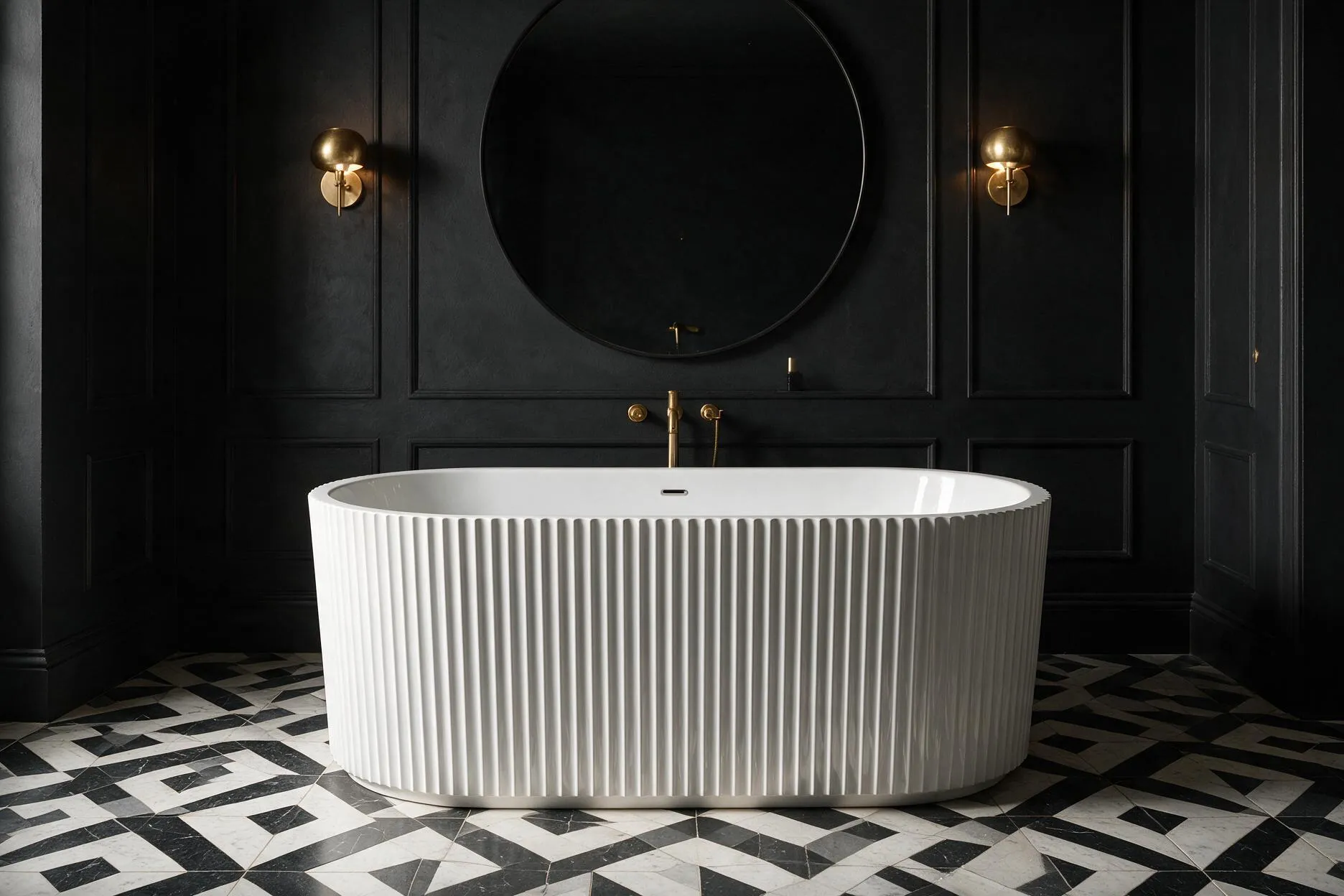
Geometry, black and brass, and considered glamour. How to bring Art Deco into a modern bathroom without it tipping into pastiche.
August 18, 2026
Art Deco is one of the few design movements that never fully left. It surfaces in a bathroom every few years, reinterpreted for whatever the current material palette happens to be — and 2026's version, built around black, brass, and unapologetic geometry, might be its most considered comeback yet.
Done badly, it tips into pastiche — too many fan shapes, too much gold, a room that reads as costume rather than considered. Done well, it's one of the most striking looks available to a bathroom.
Last updated 24 August 2026 · Elani Journal
Three things, and they matter more than any single product: geometry, contrast, and a restrained material palette. Art Deco design is built on repeated geometric form — stepped profiles, fluted or rippled surfaces, fan and sunburst motifs — set against a palette that's almost always some combination of black, white, and a warm metal. Where a lot of contemporary bathroom design softens edges and blurs lines, Art Deco sharpens them. The rhythm of a repeated shape, caught in light, is doing most of the work.
This is also why the style suits a bathroom particularly well. Water, light, and reflective surfaces are already part of the room — Art Deco just asks you to be deliberate about how they interact.
A rippled or fluted surface is the quickest way to introduce Art Deco geometry into a bathroom, since it puts repeated, light-catching form into the room's largest piece. Where space doesn't allow a statement bath, the same fluted or rippled texture works at a smaller scale, on a mirror frame or accessory set.
The Elani Deco is built around exactly this: a continuous rippled exterior, in gloss white or colour, that creates a shifting play of shadow and reflection through the day rather than a static shape. It's the centrepiece a genuinely Art Deco bathroom is built around, in the same way a sunburst mirror or a stepped vanity would have anchored the style a century ago.
For a bathroom with less floor space to give to a statement shape, the same rippled language works at accessory scale — a fluted or rippled mirror frame, a ribbed accessory set — without needing the full-size commitment of a bath.
Classic Art Deco leans on black and white as its base, with brass or gold doing the work of warmth and glamour. That combination hasn't dated — it's arguably the most durable pairing in the entire style's vocabulary, because black and white are genuinely timeless neutrals and brass reads as considered rather than trend-driven when used with restraint.
In an Elani bathroom, this palette comes together through matte black and brushed brass rather than polished or glossy versions of either — a deliberate choice that keeps the look closer to "considered contemporary" than "period pastiche." The Circa mirror — a perfect circle in deep matte black — brings the geometric discipline of the style to the wall without leaning on an explicitly Deco motif. The Edge accessory set carries the same sharp, geometric precision through to towel bar, robe hooks, and the smaller hardware that finishes a room. Where warmth is wanted, the brushed brass Aurum Collection does the same job Deco brass fittings always did — catching light, adding contrast against black or white surfaces, and signalling intention rather than afterthought.
Restraint separates "Art Deco-inspired" from "Art Deco theme park." The rules: choose one strong geometric statement rather than three competing ones, pair black with brushed brass rather than gold, favour geometry over decorative pattern, and let matte black hardware ground the palette so the room reads current rather than dated.
A few rules worth holding to:
One geometric statement, not three. A rippled bath, a fan-motif tile, and a stepped vanity in the same room compete with each other rather than reinforcing the look. Pick the strongest single geometric element — usually the bath, if you have one — and let everything else support it quietly.
Black and brass, not black and gold. Gold reads as costume in a modern bathroom; brushed brass reads as considered. The difference is subtle in a photo and obvious in a room.
Geometry over ornament. The temptation with Art Deco is to add pattern — fan-shaped tile, sunburst mirrors, patterned flooring. A single strong geometric form (the Deco's ripple, a circular mirror, a stepped shelf) does more for the look than several smaller decorative gestures layered together.
Let the black do the grounding. Matte black fixtures and hardware are what stop an Art Deco bathroom feeling dated — they pull the palette into 2026 rather than 1926. A room that leans too hard on brass without enough black nearby drifts toward traditional rather than Deco.
Start with the boldest geometric shape — typically a rippled or fluted bath — as the room's centrepiece, then build outward with matte black hardware for everyday fittings, brushed brass reserved for one or two accents, and a wall material dark or pale enough to let black and brass contrast clearly.
If a rippled or fluted bath is within reach, that single piece does more to establish the look than any amount of accessorising — the Deco in white keeps things restrained; in colour, it becomes the room's unambiguous centrepiece. Build outward from there: matte black hardware for the everyday pieces (mirror, towel rail, accessories), brushed brass kept to one or two considered moments rather than spread across every fitting, and a wall material — honed stone, deep plaster, glazed tile — dark or pale enough to let the black and brass do their work in contrast.
No — Art Deco has resurfaced in interior design roughly every decade since its origin in the 1920s, which is a longer track record than most contemporary "trends" can claim. What changes each time is the specific material palette (today's version leans matte black and brushed brass rather than polished chrome and gold); the underlying geometric language stays recognisable.
A rippled, fluted, or stepped exterior is the most authentic route — a continuous geometric texture that catches light, rather than a plain oval or rectangular tub. The Elani Deco is built specifically around this rippled profile.
Brushed brass, rather than polished gold, sits better in a contemporary Art Deco bathroom. Polished gold reads as more literally period and can tip toward pastiche; brushed brass keeps the warmth and glamour of the style while feeling current.
Yes — the geometry can work at accessory scale (a circular mirror, a rippled or fluted texture on hardware) without needing a statement bath. Keep the palette restrained to black, white, and one warm metal accent so a small room doesn't feel busy.